If 2024 was about starting—buying the domains, signing up for the subscriptions, and figuring out what “building online” actually meant—2025 was about refining.
Last year, I cast a wide net. I paid for memberships I didn’t use and tools I didn’t need. This year, my goal was to run leaner and smarter. I wanted every dollar leaving my bank account to directly contribute to two things: infrastructure(keeping the lights on) or growth (getting eyes on the projects).
Here is exactly what I spent in 2025 to keep my portfolio of projects running, growing, and evolving.
The Bottom Line
Total 2025 Spend: $1,273.11
Compared to the scattershot approach of my first year, this number feels tighter. It’s focused. There is very little “fat” here—just the engines I need to keep moving forward.
Here is the breakdown of where that money went.
1. The Foundation: Infrastructure & Hosting ($484.94)
Before you can sell or grow, you need a place to live. My biggest shift this year was locking in long-term stability rather than paying monthly premiums.
Hosting: I committed to Hostinger with a 4-year plan ($129.17). It’s a larger upfront hit, but it secures my runway for the foreseeable future without monthly billing stress. I also kept Ghost.io ($108.00) for my primary publishing platform because the writing experience is unmatched.
Domains: I’m currently managing a portfolio of projects including chironearme.org, skateboardparknearme.com, tutorlounge.me, and https://www.google.com/search?q=findcoworkingspaces.com. Between renewals and new registrations on Porkbun, I spent roughly $71.02.
Directory Tech: I invested $171.75 in GeoDirectory. Since programmatic SEO and directories are a core part of my strategy, this was a necessary tool to manage location-based data effectively.
2. The Engine: AI & Automation ($203.39)
This category didn’t exist for me a few years ago. Now, it’s my second most critical expense. I am no longer just “writing” content; I am engineering it.
Perplexity API ($115.00): This has become my daily driver for research and answer synthesis. I topped up my credits 7 times throughout the year—it’s utility bill I’m happy to pay.
GPT for Sheets ($87.00): Connecting LLMs directly to my data spreadsheets allows me to clean data and generate content programmatically.
DeepSeek ($1.39): Testing the waters with other models to see where I can save costs without losing quality.
3. Growth: SEO & Marketing ($484.79)
If I build it, will they come? Only if I have the data to tell me what they are searching for. This year, I stopped guessing and started paying for data.
Ubersuggest ($290.00): My single biggest purchase of the year. I bought the lifetime deal to stop bleeding monthly subscription fees for keyword research.
Data Scraping: I spent $74.79 on Outscraper and $45.00 on Keywords Everywhere. These tools fueled my directory sites (Skateparks, Tutors, Coworking) with actual leads and real-world data points.
Content Operations: I paid $75.00 for Typefully to manage my social scheduling. It keeps my posting consistent without me having to be online 24/7.
What I Cut (The “Anti-Portfolio”)
Perhaps more important than what I bought is what I stopped buying.
In 2024, I paid for Twitter Premium, Medium memberships, and various “shiny object” tools like WP All Import(which I refunded). In 2025, I let those expire. I realized that paying for a checkmark or a paywalled reading platform wasn’t moving the needle for my business.
Looking Ahead
My burn rate is now just over $100/month, but that includes massive one-time investments like the 4-year hosting deal and the Ubersuggest lifetime account. My actual recurring costs are much lower.
For the next year, the goal remains the same: keep the infrastructure lean, pour resources into data and automation, and let the projects compound.
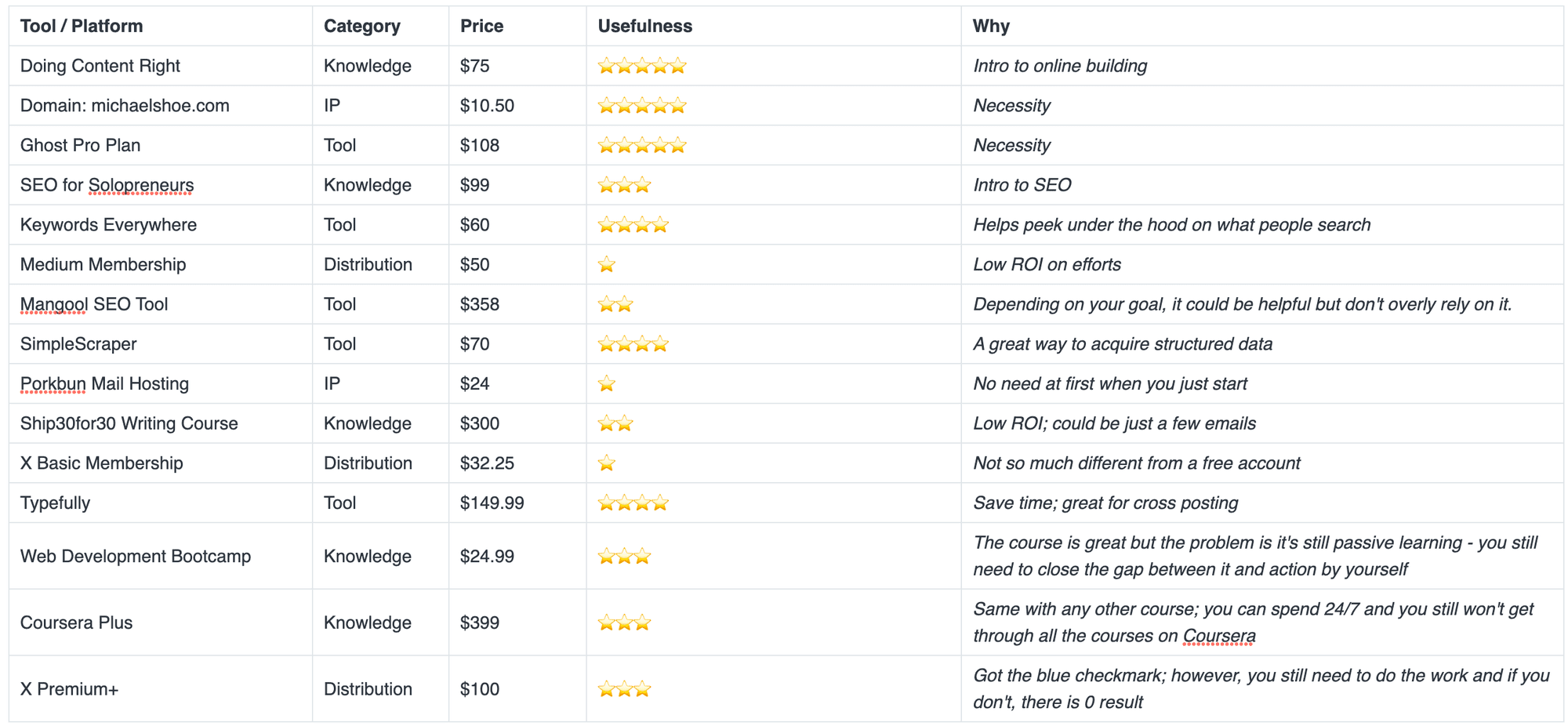
When I got accepted into business school for the 2024 intake, I faced a choice: pay a $5,000 deposit to secure my spot, or invest that money in learning on my own. I chose the latter. I gave myself permission to explore, experiment, and fail forward—building skills, not just credentials. Over the past year, I tried courses, tools, and platforms that promised to help me create content, understand marketing, learn tech, and grow online. Here’s a documentation of everything I paid for, why I got it, and how it helped me start building online.
Doing Content Right by Steph Smith
What it is: “Doing Content Right” is a beginner-friendly guide to digital content, marketing, and SEO. Created by Steph Smith, it walks you through building an audience, creating content that matters, and understanding the basics of SEO. It’s approachable for someone just starting out and full of practical advice.
Price: $150 (50% discount available if you read the intro—so $75!)
My thoughts & lessons learned:If you are completely new to the online building world, Steph did a great job explaining the different parts as well as the basic mindsets that can help you start strong. She has this rare ability of simplifying concepts, and you will feel less intimidated. The biggest takeaway I got from this book is to switch from an online consumer mindset to an online builder mindset.
Domain Purchase: michaelshoe.com/
What it is: Buying a domain is the first step to owning your online presence. I purchased my domain from Porkbun. For a non-tech person like me, this small step was a confidence booster—it forced me to get comfortable with the basics of online tools and experimenting with websites.
Price: $10.50/year
My thoughts & lessons learned: When I first landed on the porkbun site, things didn’t really make much sense – I didn’t know what I was doing but just sort of followed my intuition. Basically you are just buying a human-friendly name for your own site, which you can build content on afterwards. Don’t overthink this step, and don’t stress about making sense of it. Treat it like you are buying a piece of art at a reasonable price, a piece that you can later enhance further with your own strokes and touches. Porkbun’s support is great and responsive, so whenever you have questions, just shoot them an email.
Ghost Pro Plan (with Hosting)
What it is: Ghost.org is a content management system (CMS) focused on publishing. Hosting on platforms like Digital Ocean can be challenging, so I went with Ghost’s Pro plan. It’s beginner-friendly and comes with built-in hosting, SEO features, newsletters, and membership options—all in one package.
Price: $108/year
My thoughts & lessons learned:I followed Steph’s suggestions and built my site on Ghost. The UI is very intuitive and straightforward, which certainly helped for a non-techie like me. Ghost is also search engine friendly. However, I later learned how to build on WordPress and I’m contemplating transferring michaelshoe.com/ to WordPress to save some money.
SEO for Solopreneurs by Nat Eliason
What it is: This course teaches SEO strategies specifically for solo founders and small teams. You learn how to do keyword research, optimize content, and drive organic traffic. I followed it after Steph Smith highly recommended Nat Eliason’s approach, though I didn’t fully implement it, so my results were limited.
Price: $99
My thoughts & lessons learned:I probably could have learned everything for free on Youtube but the good thing with Nat’s course is that everything is structured. If you are new to the concept of SEO, it is still worth paying $99 for the course. However, Steph Smith’s book includes a full chapter of SEO so I’d say I might have double paid for the knowledge.
Keywords Everywhere – Silver Plan
What it is: Keywords Everywhere is an SEO research tool. It helps you check keyword competitiveness, search volume, and trends.
Price: $60/year
My thoughts & lessons learned: It’s great for planning content that people are actually searching for, but I admit I didn’t use it enough to get its full value.
Medium Membership
What it is: Medium is a platform where writers can publish articles and get paid through revenue sharing. It’s beginner-friendly for writers who want distribution without building a full website first. I started here but eventually stopped posting.
Price: $50/year
My thoughts & lessons learned:The goal of Medium is to use it as a discovery method for my blog posts. I know people are still reading on Medium, but it didn’t make sense to me after a while.
Mangool SEO Tool Membership
What it is: Mangools is a comprehensive SEO suite. It includes tools for keyword research, backlink analysis, and tracking your rankings. It’s more advanced than basic tools, which makes it useful for planning a content strategy, but I didn’t fully commit to using it.
Price: $358/year
My thoughts & lessons learned:I didn’t fully utilize all the functions in Mangool to be honest. Also I found myself doing more research than I should without committing to any actions. So I stopped using it.
SimpleScraper Membership
What it is: SimpleScraper is a web scraping tool that lets you extract structured data from websites. I initially bought it to research property prices, but it can also be used for competitive analysis, lead generation, or market research. A powerful tool for data-driven projects.
Price: $70/year
My thoughts & lessons learned:This is a great tool but there are also many other similar web scraping tools out there. You may try whichever one you like.
Porkbun Mail Hosting
What it is: This service allows you to send and receive emails from your domain (hi@michaelshoe.com). It gives a professional impression, but as a beginner, it wasn’t necessary—I could have used Gmail instead.
Price: $24/year
My thoughts & lessons learned:You don’t need to complicate it when just starting; and people won’t treat you differently because of it.
Ship30for30 Writing Course
What it is: Ship30for30 is a cohort-based course designed to help new writers start publishing daily content. It’s great for accountability and community support.
Price: $300
My thoughts & lessons learned: I ended up getting a refund because of the price and some repetition in content, but the structure is solid for beginners.
X Basic Membership
What it is: The basic X membership allows posting longer-form content on X (formerly Twitter), which is essential for growing an online presence as a solopreneur or writer.
Price: $32.25
My thoughts & lessons learned:To be honest, paying for a membership especially a basic one doesn’t make sense. You don’t get the blue checkmark anyway and there are no effects on your contents’ impressions. At the end of the day, it’s still about the quality of your content.
Typefully
What it is: Typefully is a productivity tool for writers. You can schedule posts, cross-post to platforms like LinkedIn or Bluesky, and manage your social media workflow efficiently. It’s helpful if you’re serious about building an audience.
Price: $149.99
My thoughts & lessons learned:I was fairly serious and committed in writing online, so typefully made sense for me since I was able to cross post on LinkedIn, X, BlueSky, Threads, etc. The tool is very easy to use and intuitive, with LLM built in helping with your tone and writing etc., saving many hours potentially.
Web Development Bootcamp 2024 (Udemy)
What it is: This Udemy course teaches HTML, CSS, JavaScript, and other web development fundamentals. Steph Smith recommended learning before creating content, and coding gives you the flexibility to build your own web projects.
Price: $24.99
My thoughts & lessons learned:I didn’t really finish this course because it is so long… The content is really good and each session is very compact; however, I just don’t think passive learning is going to help me with building (anymore). I probably finished 50% of the course.
Coursera Plus Membership
What it is: Coursera Plus gives access to hundreds of courses. I used it to take Investment and Portfolio Management by Rice University to build knowledge in finance and investing. It’s a great all-in-one subscription for lifelong learning.
Price: $399/year
My thoughts & lessons learned:I definitely learned the building blocks of investment and portfolio management. However, like any courses of passive learning, the results won’t show up automatically and when you take actions, you still need to fill in the gaps on lots of fronts.
X Premium+ Membership
What it is: X Premium+ provides advanced posting tools, analytics, and visibility benefits. After investing in content creation and building my profile online, I decided to double down on this platform, especially with a Black Friday discount.
Price: $100
My thoughts & lessons learned:I mainly did it because of the end-of-the-year sales.
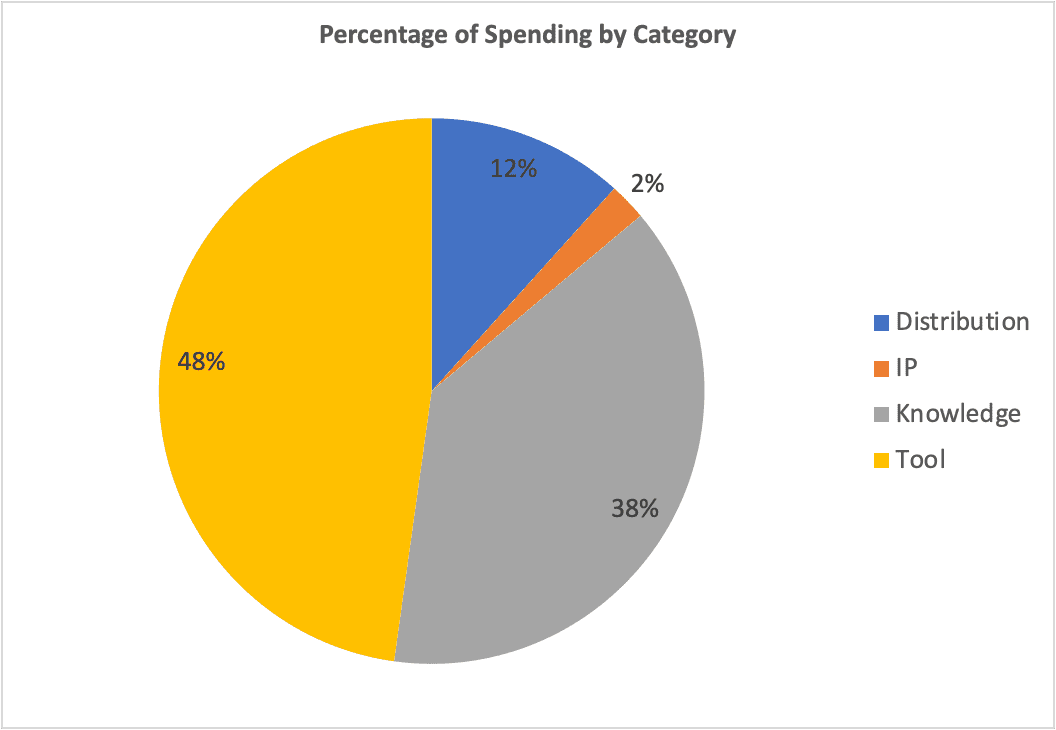
Expenditure Analysis and Ratings
Learnings from the first year of building online
I invested heavily in knowledge and tools, but inputs alone don’t create results—I need to tie every tool or course to a concrete output to truly benefit.
I experimented with many overlapping tools and platforms, but depth is more valuable than breadth—focusing on a few key tools and mastering them is more effective than spreading myself too thin.
I spent time learning before monetizing, but learning must be paired with action—even small experiments that generate revenue are better than perfect knowledge without application.
I consumed multiple courses and resources, but knowledge is most valuable when applied—by turning lessons into tangible projects, I can accelerate skill development and track real-world outcomes.
I started small with IP and distribution. However, low-cost experiments are essential—they allow me to test ideas, explore channels, and gain insights without risking significant capital.
I tracked spending loosely this year, and I learned that tracking ROI is crucial—documenting cost, effort, and outcomes for each investment helps me optimize future spending and avoid wasted money.
What I’m thinking about the year (2026) ahead – a “writing as thinking” post
I normally start my writing with a clear topic/thesis of where the article is going to land. Not this one. Writing, to me, is also a vehicle of thinking facilitation; if I cannot clearly put it on paper, I don’t know what the answers are.
And right now, I don’t know what the answers are for my 2026 strategy, and I hope I will manage to land it somewhere as I write this post.
Learning
The first thing off the top of my head
Is to learn how to better use AI products. I’m not technical (or maybe I shouldn’t keep saying that for the sake of self-fulfilling prophesy), so I’m not the far end of the value chain participation spectrum – aka. I’m just a user. However, I do use ChatGPT on a daily basis for the better part of 2025 for work/ personal projects, and I 100% saw and believe in the level of difference it makes to my professional and personal life. If you think about it, IRL not many skills will have this level of leverage and impact where 100 unit of effort (input) can make more than 100 unit of result (output). So doubling down on keeping up with AI products is the way to go.
As a ChatGPT free tier user I naturally gravitate towards upgrading to a Plus membership, but unfortunately it is not available in my region. So I settled for Google AI Pro by clicking the “Upgrade” button on Gemini, and I’m starting to at least use Gemini together with ChatGPT. Google AI Pro does include many cool products, sometimes experimental, on top of the Gemini chat app, which is something I’ve always wanted to learn more about. But definitely will take some time to get used to though.
Some other reflections on understanding AI
AI means many different things to different people. Since I embarked on this journey of creation/building, I believe AI has managed to lower the barrier by magnitudes. If we are solely talking digital building, it can mean:
Photos/ images
Code
Video
Music
Writing (or storytelling)
Data analysis
More
Suddenly AI becomes this fundamental skill that can be applied to any of the field above, where traditionally one would have to go through years of proper training before seeing any substantial result.
But what is this skill of “AI”?
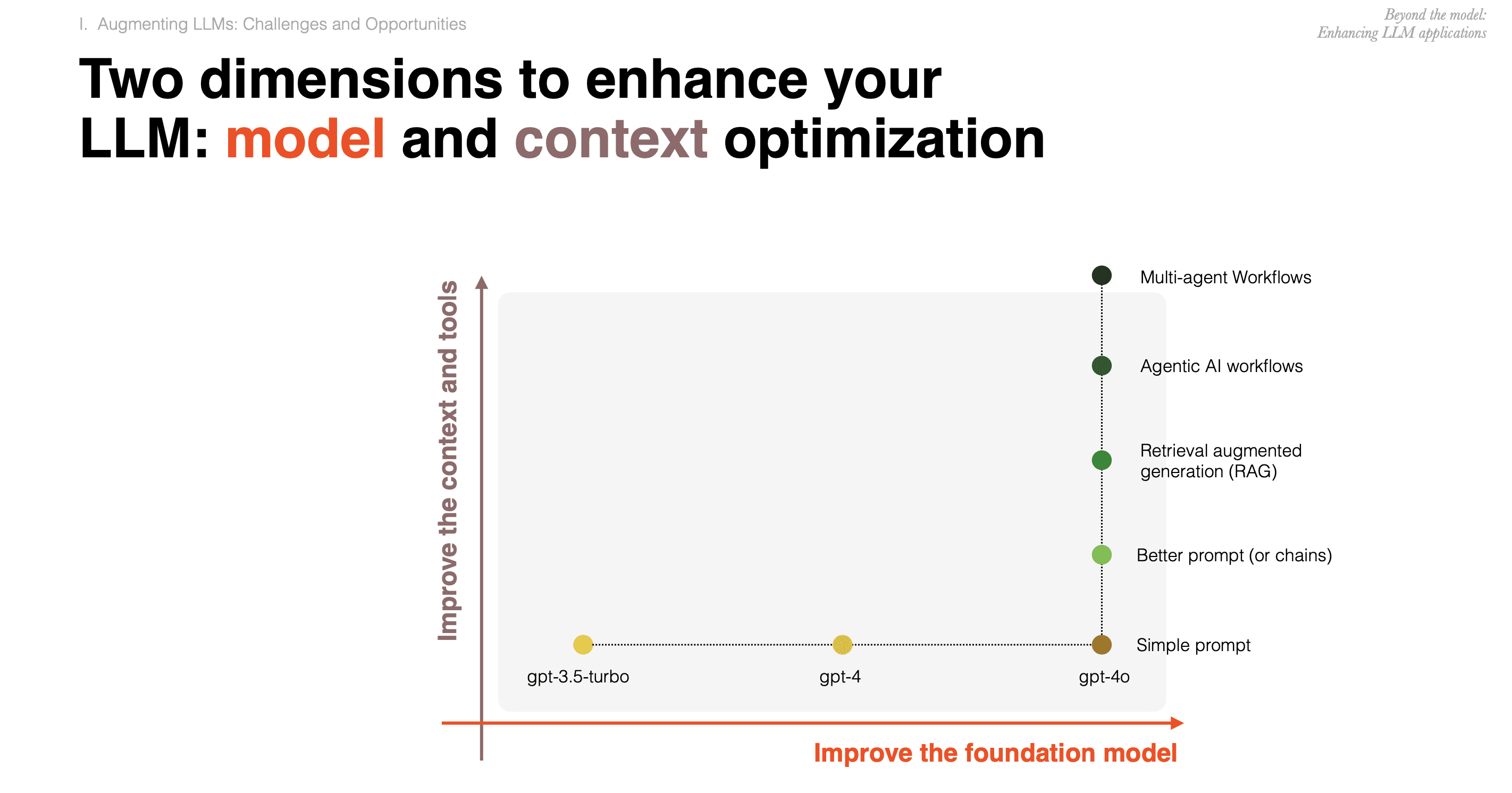
To me, and I assume to many other people too, AI is just the same as LLM (which apparently is not but I just don’t know the difference so I just use them interchangeably). There are many different models, newer and more powerful models as time goes by. But even with the same model, there are different skills such as few prompts, chain prompts, RAG, and so on that can greatly improve the results one gets. Below is a screenshot of a slide from Stanford Online CS230 (Lecture 8).
With the fast development of AI, should I still learn how to code?
I definitely had this doubt. With the recent news of programmers getting laid off and new CS graduates having a hard time getting jobs, this doubt is also on the minds of many.
Dr. Andrew Ng, in CS230’s Lecture 1, gave his opinion – which is a resounding YES. Dr. Ng laid out four layers of technology:
Gen AI
Deep Learning
Machine Learning
CS Fundamentals
Where each technology sits on top of another. CS fundamentals just sit at the very bottom. The tech on top won’t exist without those below it.
In addition, Dr. Ng also mentioned that as one builds AI applications with the help of external LLMs, the size of the bills one receives will grow exponentially as more users get on the application’s platform. Understanding the techniques of deep learning (as well as machine learning and CS fundamentals) will help greatly reduce the bills.
For me personally, all four layers are black boxes. However, I do believe that one should still learn how to code from my personal experience. Since English is my second language, many people allege that LLMs might render learning languages a waste of time and energy. I 100% disagrees with this because I don’t just use LLMs as tools to translate; I partner with them to think, read, and brainstorm ideas and work with them for execution. More importantly, it is up to me for the final judgment of whether or not the LLM should keep iterating; if I don’t speak the language, there is no way I can decide. The same thing goes with knowing how to code – you have to be the final judge.
I’ve had many failed attempts at learning how to code in my life. As a matter of fact, I still have an unfinished courses on web development. Somehow I just cannot seem to get the gist – there is really no “click”. I’m watching Stanford Online’s CS105 which is a basic computer knowledge course designed for non technical people, and so far it is quite straightforward.
Investing
My thesis to investing has been pretty passive. I don’t hold a lot of assets, most of which are S&P 500. I also hold a small amount of European ETF, some bond ETF, as well as Gold ETF.
Because of my education and work experience, I have some very specific knowledge on the sport and entertainment industry. Recently I listened/watched the My First Million Podcast where Shaan talked to Chris Camillo on his investing strategy. It left an impression on me, because what he mentioned as “observation based investing technique” is really based on specific knowledge about a company and industry.
In order to leverage my knowledge for investing, I need to further obtain at least some investment techniques, and some basic knowledge of finance and how the financial market works. I’ve tried to take Aswath Damodaran’s Valuation Course, and may pick it up again next year. This will help me with both investing and content creation.
In 2026, my investment will likely still be dominated by passive investing, i.e. equity and bond ETFs. I do want to allocate a portion of asset for active investing, just for the sake of trying and learning. Because of my professional background, I might look at companies such as TKO, Disney, or Netflix, which are in the entertainment and media business.
Building
Building side projects changes who I am. I started doing so in early 2024, and has been writing, creating, and building stuff online ever since.
For one thing, I used to be a believer in traditional careers until about 2024, in the sense that I will improve the wellbeing of me and my family if I keep contributing in the workplace. I’ve been a beneficiary of the traditional careers, and I was able to support myself with a modern lifestyle. During this time, I tied my identity to being a manager, and I don’t really have any “hard skills” such as coding, wood work, the ability to fix mechanics, etc. I don’t value skills like these, but rather the vague skills of “management” – i.e. it is MANAGEMENT that creates and improves value. However, I have taken growth for granted, and confused it with my own capability.
Right now, although I still have a day job, my priority has shifted. Instead of trying to increase my chance of a better job, a promotion, or exposure in the industry by attending conferences, I just treat job as – a JOB. Nothing more. My identity is not tied to my position. My job just provides to a means for me to support my family and a platform for me to build without getting stressed about making money right away.
This whole identity shift also manifests in my info input (or it could be the other way around too). While I used to read and watch a lot the great CEOs or management types of books, I now try to know as much about builders, entrepreneurs, and creators, etc. Then everything trickles down to my daily activities as a result.
Building is hard; what’s even harder is building something people want, aka. willing to pay for. I still am trying and to be honest, I don’t know if I have something people are willing to pay for.
Other than the things I have tried building and writing (yes, I put writing and creating online in the same bucket as building”, the first idea off the top of my head RIGHT NOW is:
Financial Literacy for Children.
Why? Because that is my own itch. I have little ones at home, and I want them to be equipped with the right mentality from the start. I haven’t had such an environment growing up and only started to learn about it in my late 20s. Knowing how much I would have benefited from such knowledge if I had had it in my childhood, this is what I want for my children.
I have identified some great resources provided by organizations such as FDIC, CFPB, etc., but their stuff are just … too dry. Children will benefit from such great resources, IF ONLY they have the patience to read about them. That is the gap to be filled.
This is really just a preliminary thought on the problem – a problem that I have and someone else might as well. Other than that, I don’t know anything – what types of products might work the best to solve this problem, what types of distribution might work the best, etc. But at least that is a starting point for my 2026’s building journey.
My life’s thesis
Overall my life is about owning and preserving the value that I have created. I have ignored this for my whole life by emphasizing ONLY on climbing the career ladder, looking for better jobs, etc. To me (now), this is not getting one’s priorities straight. So now, whatever I do, I ask myself the question: am I adding value or creating something whose value might increase with time? And the answer must be a resounding YES before I wholeheartedly put in efforts. Otherwise, I make do.
2026 Roadmap (aka. Task List)
I started writing this post with the hope that I will identify some things to work on for 2026, and I can happily declare the goal is achieved. These are my 2026 task list items:
Use Google AI Pro (Gemini, and other stuff) to create – long term
Also, use AI when I do anything
Keep watching CS105 on Youtube – recent
Aswath damodaran valuation course
Test investing (valuing) in entertainment and media companies
Not an investing endeavor only but investing/ learning/ writing
Use the publicly available resources for financial literacy education of youngsters (FDIC, CFPB, etc.) to create contents and products, etc.
To one (of many more) productive and prosperous year ahead!
Not because I don’t have time — but because I lack the energy.
Even the smallest tasks, like replying to an email, feel heavy. Every action demands more than I have to give.
It’s not burnout, exactly. It’s more like my mind hasn’t recovered. My body might be fine, but my head isn’t there.
In my younger years, I would force myself to push through it. I thought that was discipline — being tough, staying on track no matter what.
But it’s not discipline. It’s denial.
Because in life, there are things that drain our energy and things that restore it. The real discipline is in knowing which is which.
Everyone needs energy to function, especially if you’re trying to perform at a high level. You can have all the time in the world, but if you don’t have the energy, nothing moves.
So what should you do when you have no energy? Simple: do things that help you restore it.
For me, that’s writing. It’s my way of thinking clearly — a way to rebuild mental order when everything feels scattered. When I write, my thoughts realign. And slowly, energy comes back.
For someone else, that might be cooking. Or making tea. Or spending time with people who refill your tank instead of draining it.
Time isn’t an absolute thing. It only matters when it’s paired with leverage and energy. That’s when you see progress.
Until then, it’s okay to pause — and let yourself come back to life.