Why do we need to read a Balance Sheet? It’s not fun.
The goal is to understand how a company actually works.
Although we understand the asset items now, they are isolated from one another. How can I “see” a real company when all the pieces of asset items are put together?
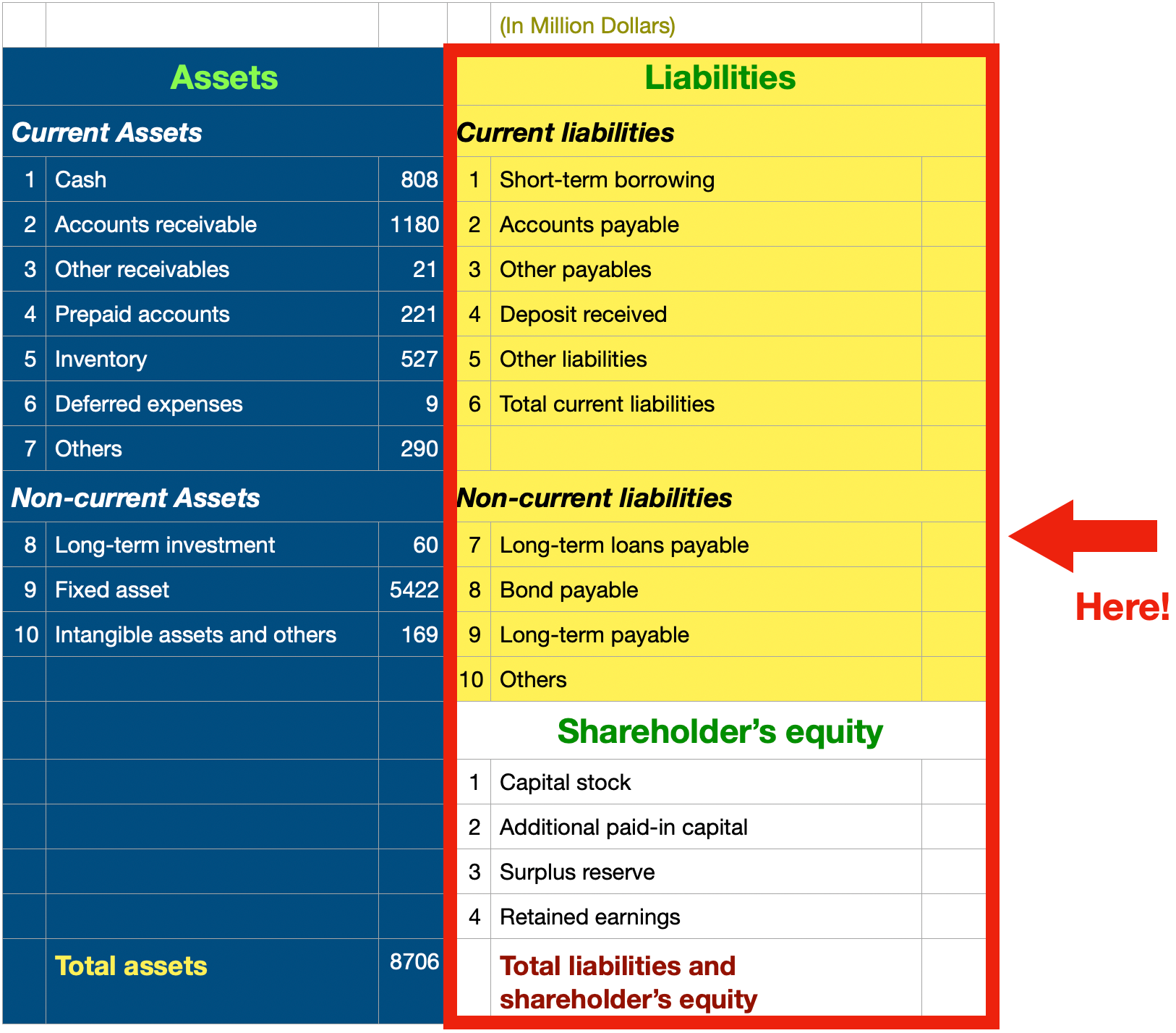
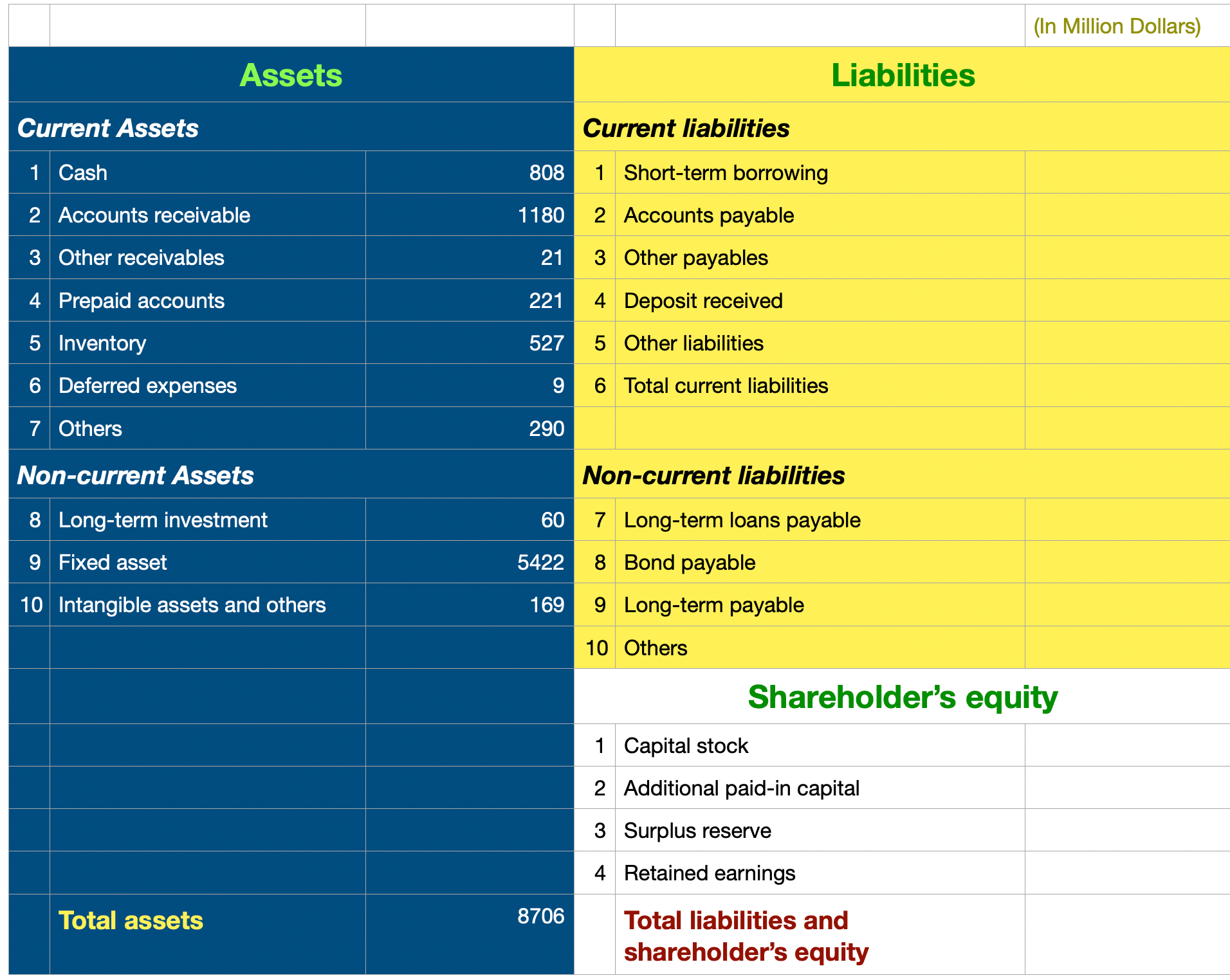
This is truly about how to “read between the lines”. Let’s look at the same Balance Sheet again.
Manufacturing Companies
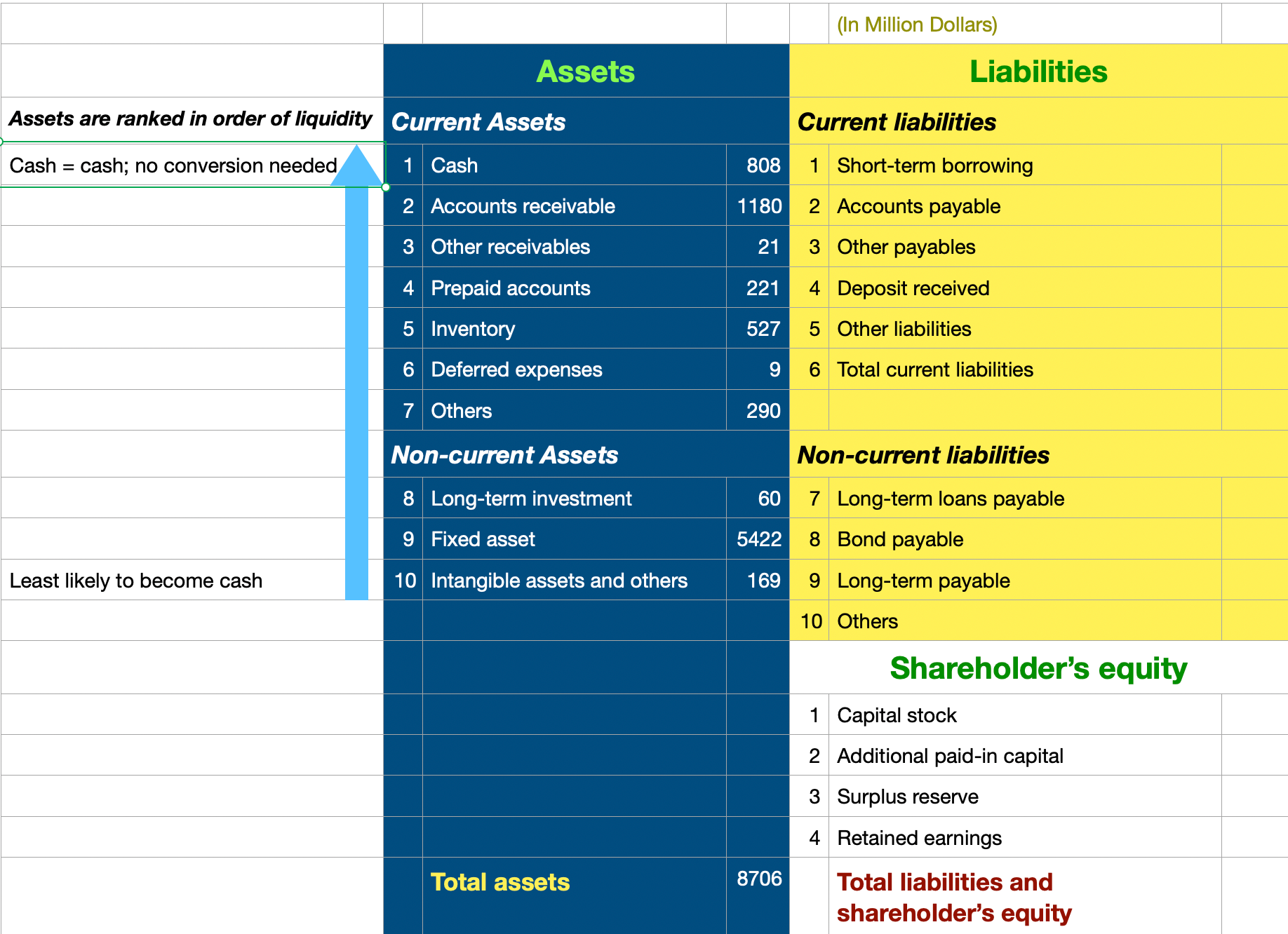
Can you identify the biggest asset of this company?
If you check carefully, you may discover that fixed asset is the largest item of asset. For this company, the total asset is around 5.4 billion USD.
What about the second largest asset item?
Accounts Receivable – it’s worth about 1.2 billion USD.
If a company’s largest asset is fixed asset, and the second largest one is accounts receivable, what business do you think the company is in?
This is pretty easy to guess. And yes, you might have guessed it – it is a manufacturing company. What’s more, it is a capital-intensive manufacturer requiring upfront asset investment.
What about competition?
Considering that its second largest asset is accounts receivable, and accounts receivables allow our customers to pay later, making our goods more competitive in the market, it’s safe to say that this company is facing serious competitions in the market.
As a matter of fact, high fixed assets, high accounts receivables are two traits commonly found in most competitive manufacturing companies.
Service Companies
In our daily lives, we might face more companies in the service industry, and for most of us interested in entrepreneurship, manufacturing is not something we look forward to starting a company in. So what does the balance sheet of a service company look at?
Let’s use a design company as an example.
A design company is essentially just a bunch of people working on their computers in an office. You may guess intangible assets are what the design company has, such as brands, technology or even goodwill. But what if this is a newly formed company, with neither brand power nor goodwill, and it solely relies on brains and has no patent?
For this infant company, the most valuable asset of is people – the employees. This is easy to understand. But how can “people” be reflected on the balance sheet?
Maybe under intangible asset?
Or fixed asset?
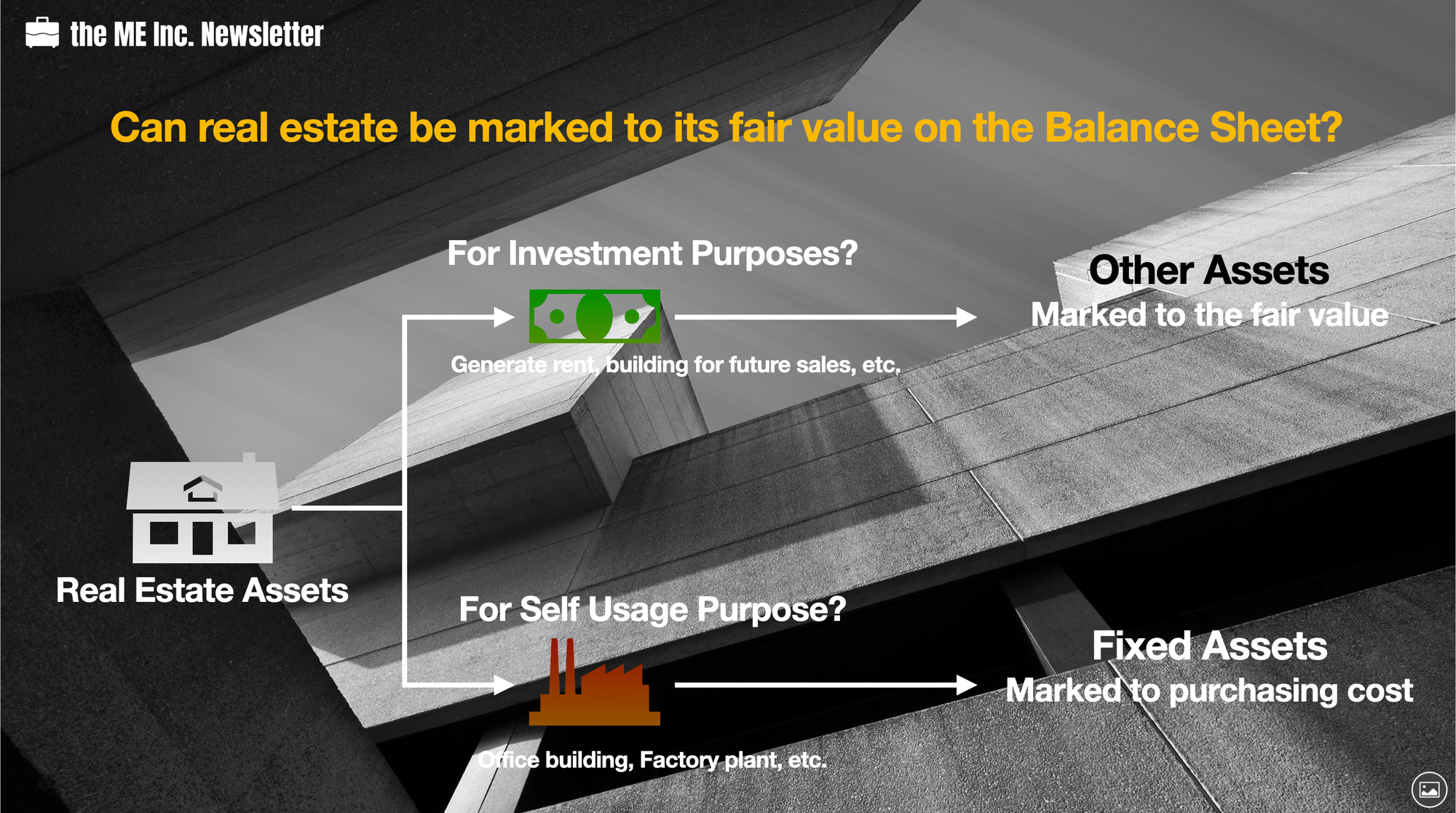
The answer is actually neither. Even for companies whose most valuable resources are people, such as a design company, they won’t put people under the asset.
Employees are hired, not owned by the company. They are not assets that can be sold or disposed.
Pro Sports Clubs and Pro Athletes
But is there any scenario where people actually become assets?
Well, there actually is.
Professional athletes in Europe or North America get paid huge salaries for performing at the highest level on earth. We often hear that pro players get multi-million contract extensions. Within the contract period, the athletes play for their own franchises, but the franchises can also trade players with other counterparts. In this case, professional athletes are more like assets, which can be bought or traded among multiple parties (clubs). For example, if a club signs a $150 million, 5-year contract with a star player, that money should be put in the deferred expense item, since the player contract is creating some future benefit to the club.
Agricultural Companies
Now we have looked at people, what about animals? There are many companies in the agriculture industry.
For these companies, animals such as chicken or pigs are referred to as biological assets. Animals and plants all belong to this category.
Let’s say I have a farm cultivating chicken. Where should I put my chicken on my balance sheet? Well one thing for sure is that there won’t be an item called chicken.
I’m tempted to treat my chicken as goods; so I should treat them as inventory. However, that might only work in half the situation.
Since my farm cultivates both roosters and hens, I will need to treat them differently. Well roosters are cultivated mainly for the meat, hens are actually for the eggs. From this perspective, roosters should be treated as inventory, because they can turn into cash in a single cycle, while hens should be treated as fixed asset since they last longer than a single cycle and can generate future value.
As we learn deeper and deeper in this topic, you may find out that except for financial sector, almost all industries use the same format of financial statements. However, behind the same format are vastly different companies operating in different industries with different business structures. The same asset item may have completely different meaning in different industries too. When all these assets are organized, they paint a picture of a real, lively company.
To clearly describe the economic activities of a company, a company first needs a Balance Sheet. The reason is to understand what the initial investment has become, and whether its value is maintained.
This is what Balance Sheet looks like.
A Balance Sheet is mainly divided into two columns, one on the left and one on the right.
On the left, I got my Assets. On the right there are 2 things listed. The one on the top is called “Liabilities“, the one on the bottom is “Shareholders’ Equity“.
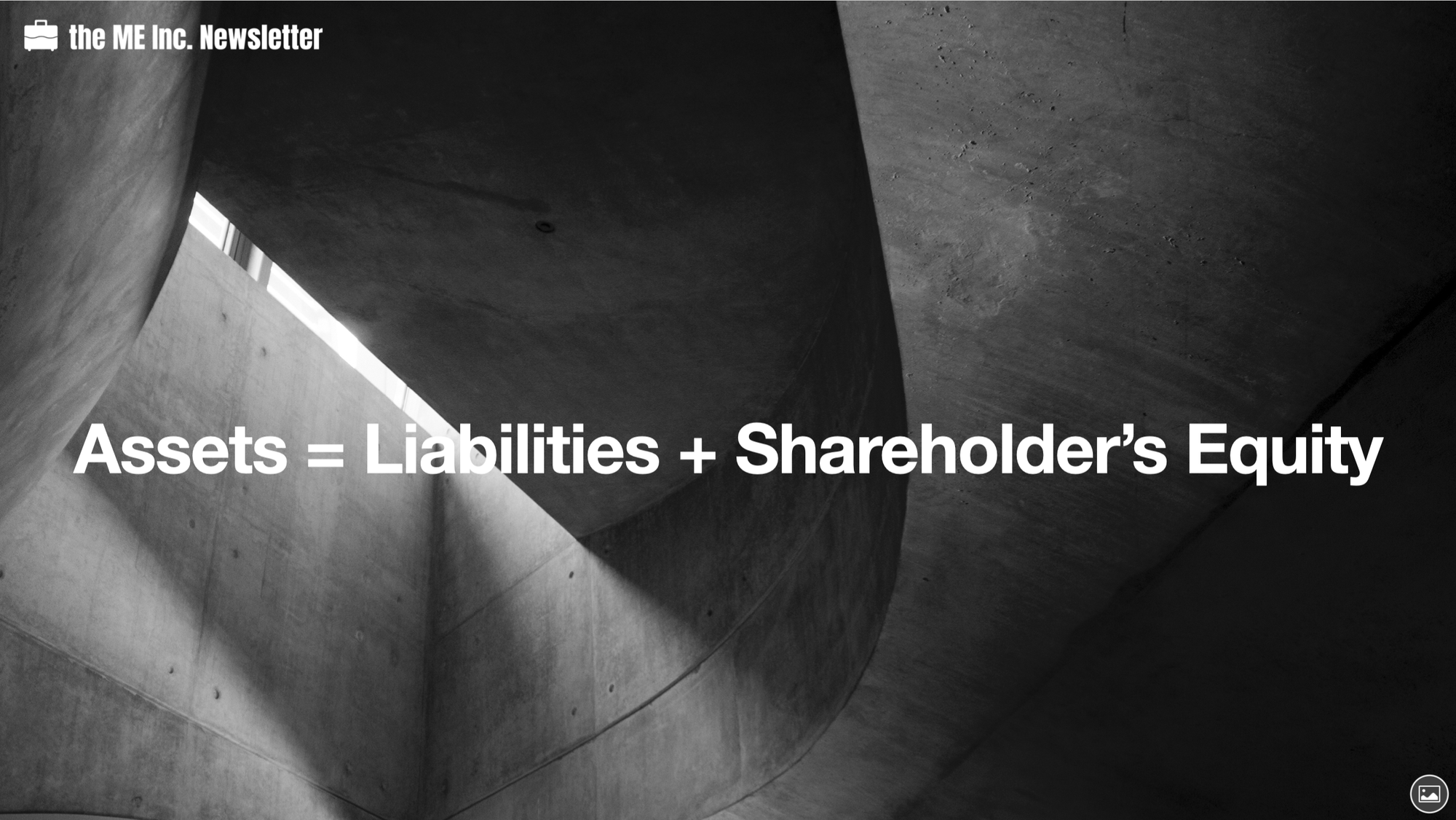
There is a very important equation called Assets = Liabilities + Equity, but we don’t have to worry about it now. First, let’s tackle each item one by one.
Let’s look at Assets first.
There are two types of assets, Current Assets and Non-current Assets. I will dive into their differences later on, but for now just know that in general, Non-current Assets are more durable and more valuable than Current Assets, and they are less likely to turn into cash. We will dive into Current Assets first.
Current Assets
Cash
The first item we can see is cash and cash equivalents – the good old money. Whether it’s parked in a bank or retained as actual cash in the company, it’s all cash or cash equivalents.
Accounts Receivables
Why do we have Accounts Receivables? When I sell products, the buyer may not pay me right away. This is actually quite common in the business world. Though I may not like it, but because I don’t want to lose this client, I’d rather let him pay later than never, and sometimes I will even bear the risk of not receiving the money at all. A lot of times, I’m doing this out of necessity because of similar terms extended to customers by competitors.
In this case, say I sign a contract stipulating the payment in two months, I have earned the right to receive payment at a later time (two months later). This right is called Accounts Receivable.
Other Receivables
After that there is a special item called Other Receivables. A common type of other receivables is money advanced to employees for specific purposes such as business trips. In normal business operations, a company shouldn’t have a large amount of other receivables.
Prepaid Accounts
The next item of asset is Prepaid Accounts. Unlike Account Receivables, which are money owed to me by customers, prepaid accounts are money prepaid to my suppliers in the form of deposits. For example, if a supplier has products that are very scarce to get, I’d rather pay him in advance so as to secure the materials.
Prepaid accounts give me the right to receive products/services from the supplier at a later time, making them part of the asset items.
Inventory
Inventory is pretty straightforward. It can be raw materials, half-finished products, or finished goods. For example, I might be producing metal cups and steel is the raw material that I will need to purchase. After that, I will cut them into smaller pieces (half-finished products), before I finish them into products ready for shipping (finished goods).
Deferred Expenses
The next item of asset is relatively hard to understand, which is called Deferred Expenses.
Let’s use an example. Considering that my metal cup business is booming, I’ve hired more staff to handle not only production, but also order fulfillment. These staff members will need to use stationary such as pens, pencils, and paper etc. Every time I buy office stationary, I will buy everything for about six months usage.
Now suppose I spent $60,000 on a large batch of office stationary, and then stored them in a warehouse for people to use in the next 6 months. Now the question is this: are the office stationary stored in the warehouse assets or expenses?
💡
Obviously we first need to understand the difference between assets and expenses. We know in fact assets and expenses have one thing in common, which is that both will result in cash outflows, i.e. I pay money for them. However if the cash outflow brings back something useful in the future, that something is considered an asset. If not, it’s simply an expense.
For the $60,000 office stationary stored in the warehouse, obviously they can be used in the next six months. Therefore, it’s serving some future purpose, so they should be considered as asset.
Now let’s consider this: let’s say in a month, my team will use around $10,000 worth of office stationary. By the end of the first month, I will have $50,000 worth of stationary; by the end of the second month, $40,000, etc. In this case, I’d say each month, $10,000 worth of stationary is expended, and the rest in the warehouse are deferred expenses. After six months, all $60,000 of stationary will be expended, and I should delete it from my assets.
Other than office stationary, what else could be considered as deferred expenses?
Well, my cup selling business might be doing extremely well, and I may decide to enter the retail business myself. I will pay a sum of money, say three months rent, for a retail space to display and sell my line of products to consumers. Since I pay the rent at the beginning of the first month, it should be considered deferred expenses. I may engage an advertising agency to help me promote my brand, and I might pay a six-month advertising budget in advance. If you follow this logic, you may find other expenses such as annual software subscriptions, company gym memberships… You get the idea.
Current Assets vs. Non-current Assets
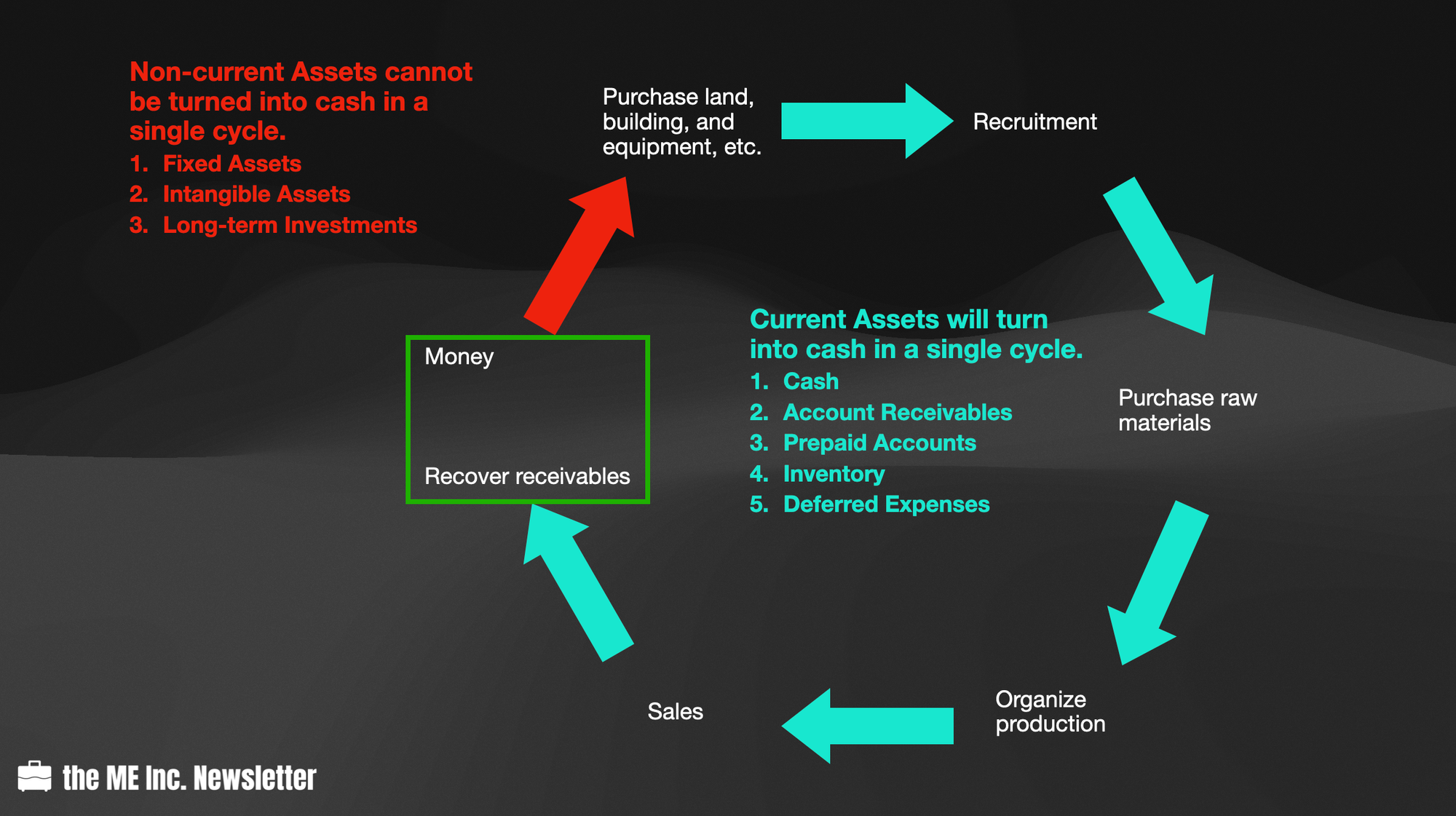
For all of the asset types that we have mentioned so far, there is one thing in common: they are all liquid assets. In accounting liquid assets are called Current Assets.
There is another group of assets called Non-current Assets. What’s the difference then? Let’s pick an example from each of the 2 groups of assets to compare.
From Current Assets, let’s use Inventory as an example. As mentioned, inventory includes raw materials, half-finished products, and finished goods. Let’s take a look at raw materials. Now let’s also pick something from Non-current Assets, say fixed asset. Fixed assets include property, plant, and equipment. Now let’s pick Equipment as an example.
What is the main difference between inventory and equipment that makes the former liquid, or current, and the latter illiquid, or non-current?
Raw materials are turned into finished goods soon after they are received. These finished goods are then sold to bring back cash. In other words, raw materials, which are bought with cash, become cash again within one cycle. Equipment, on the other hand, is not expended immediately, and can take years to deplete its entire value.
💡
The biggest difference between Current Assets and Non-current Assets is whether it can be turned into cash within a single cycle.
If you pay closer attention to Current Assets, you may find out that all items on the current asset list are ranked by their order of liquidity, i.e. how fast they can be turned into cash. For example, why are cash and cash equivalents ranked in the first place?
Well cash is cash, and no conversion is needed. So it obviously is the first. Accounts Receivables will become cash once they are collected, so they are ranked in the second place. Inventory needs to be sold, converted into Accounts Receivables, before it can be converted into cash. So it is ranked after Accounts Receivable. This is how we rank the assets.
Non-current Assets
Now let us take a look at the non-current assets.
Fixed Assets
Fixed assets are a type of non-current assets, among which are properties, cars, computers, and so on. To be considered a fixed asset, the asset must be durable, and must have relatively high value.
Should my five-year old cup be considered a fixed asset? Say I’m extremely frugal and I use the same cup for the past five years. Is it a fixed asset? The answer is NO. Even though the time frame is long, the value of a cup is simply too small. A fixed asset must qualify for both standards.
Intangible Assets
Next, let’s look at Intangible Assets.
Intangible Assets include patents, proprietary technologies, copy rights, franchise license, trademark, goodwill, etc., things that are crucial to a company but do not exist in physical forms. In certain countries, it can include land usage rights, mining rights and other types of commercial rights.
Long-term Investments
Last but not least, Long-term Investments also belong to the Non-current Assets family.
For instance, the company may own shares of another company, or it may have bought government bonds. As long as I plan to hold the investment for the long term, they can be called long-term investments.
💡
Long-term investments can either be equity investment or debt investment.
Learning about accounting is hard, but necessary, as it’s the language of business entities. Next time, let’s look at how assets are valued.
The foundation for any financial analysis is financial statements.
You might have heard about the three financial statements, which are Balance Sheet, Income Statement, and Cash Flow Statement.
However, do you know why most countries require companies to prepare these three particular financial statements, not something else?
To answer this question, let’s think about why we need financial statements at all.
We prepare financial statements to describe the economic activities of a company. A company may carry out many economic activities. Depending on the industries, companies could look very different from the outside.
How can we describe these economic activities in a clear fashion, regardless of their size, industry, or even country of residence?
First, let’s think about this: what kind of economic activities take place in a company?
Economic Activities in a Company
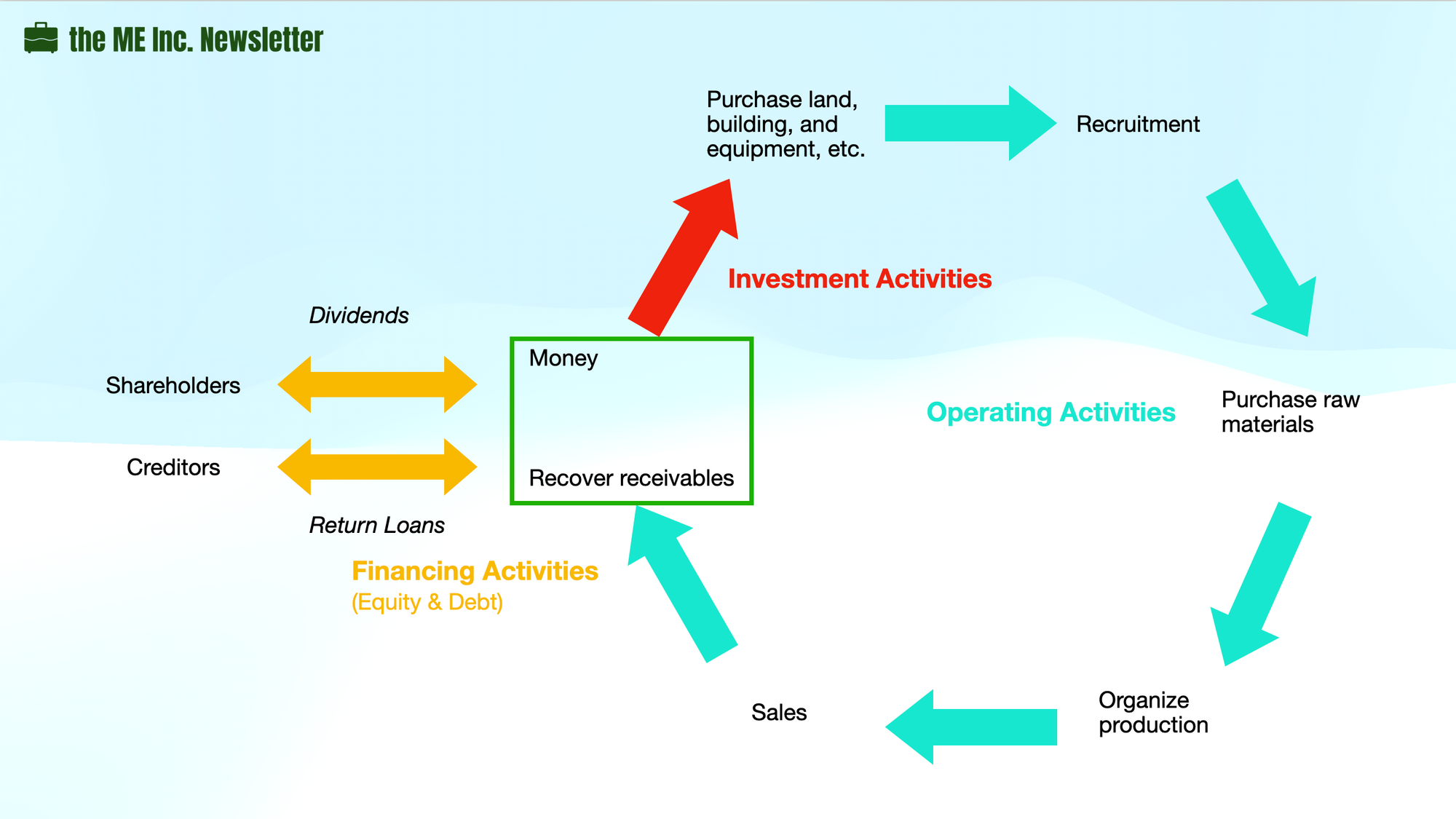
From the perspective of accounting, there are only three kinds of economic activities, which are operating activities, investment activities, and financing activities.
The first type is operating activity.
What are operating activities? In short, operating activities describe how a manufacturer produces products, sell the products, and collect receivables every day, i.e. the core of why the business exists.
The second type is investment activity.
What are investment activities? Well, a firm may open a new office, enter a new area of business, or develop a new product line. These activities are currently outside of the business’s core economic activities, and would normally require new capital injections.
During the process of operation and investment, if the firm lacks capital, it may choose to borrow from banks,
or raise money from external investment firms such as venture capitals. These are financing activities.
There might be thousands of transactions happening every year, all of them will find a place in any of the three economic activities.
Next, let’s look at how these activities take place in a company.
Let’s say that I want to start a company. The first thing I need to do is to establish a business entity, i.e. register the new company as a standalone business entity. Once the business entity is registered, my new company is formed.
At this moment, all my company has is a pile of money – the initial capital injected from my personal bank account to the company’s bank account.
Therefore we could say that the starting point of all companies is a sum of invested funds.
However, I’m not simply moving funds just for the sake of depositing it into a bank; I want the company to make a profit.
Suppose I want to set up a factory. Obviously the first thing I have to do is to build the factory plant and purchase the equipment. After having all the infrastructures established, I will need to purchase raw materials and hire staff. Now that I have secured the plant, equipment, technology, workers, and raw materials, I can start making products.
And I must be able sell my products to earn revenues – my ultimate goal.
When I sell products, more often than not, I will not able to receive cash right away. All I got is a bunch of account receivable – the right to receive cash from the buyer at a later time.
When I do receive the sales proceeds in cash, I can then use it to pay down bank loans, or pay dividends to shareholders.
The repeating cycle: money – things – money
The Repeating Cycle
Every company’s economic activities can be abstracted into this constantly repeating cycle, regardless of industry, specific business, and developmental stage. This cycle starts with invested funds in cash and ends with received sales proceeds in cash. Now let’s examine if the above three economic activities have happened during the cycle.
When I start the company, I may not be able to provide all the initial investment by myself. Instead, I may need to borrow money from the bank.
This is obviously a financing activity.
Then I take the invested funds to build factory plant, purchase equipment, and may subsequently invest into other companies, or establish a joint venture with someone else.
All of the above are investment activities.
Once I have all the infrastructures set up, I will purchase raw materials, produce goods, market products, and receive cash from sales. This process repeats over and over.
These are operating activities.
Why We Need Financial Statements
My goal for starting a company is to make money, or generating cash, and I want to receive more cash than my invested cash. A company that achieves this goal is making a profit.
However, only answering this question is not enough. An even more fundamental question is: what happened to the principal of my investment? Though I don’t want to see my company losing money from operating activities, I definitely don’t want to lose my initial investment.
If you can recall, my company’s initial form is just a pile of cash, lying in the company’s bank account. However, after investing in all kinds of infrastructure, the pile of cash – or the principle of investment – is transformed into varies kinds of stuff such as fixed assets. In this process, it’s important that I understand what my initial investment has become, and how much it is still worth.
That is what Balance Sheet will tell me.
Income Statement and Cash Flow Statement serve other purposes in similar fashion. By examining all three statements and their interrelations, I can draw insights for my company that I wouldn’t be able to otherwise.
My journey of setting up an online business officially started in 2024. Though progress has been slow, I have learned so much along the way nevertheless.
I started the process since 2022. I was experiencing some personal stuff and became less sure about my career path – a path where I intended to advance step by step on a career ladder in the sports industry.
So how did I set out to make a change?
I first changed my information digest. Before I only read news and stuff about the sports industry, then I decided to give something else a try.
My first change was to listen to lectures at the Startup School by YC. You know, Sam Altman, Paul Graham.
Then I went down the rabbit hole of online, tech, etc.
The result has been nothing short of surprises.
My closest friend started to notice changes in the things I talked about. From sports to tech, investing, finance, and entrepreneurship.
And I started to understand more on businesses, especially starting businesses.
Starting (or building) a business is categorically different from managing a business. Though I was in charge of management and operations for my day job, I never had to come up with product ideas.
During this journey, I made long lists of what I wanted to work on:
MBA application consultant but in a chat-box with AI
MBA community platform
Productivity APP
Visualized annual report database
MBA qualified scholarship resource
Midlife experiment podcast
How to learn podcast or Youtube channel
Time Budgeter APP
A local APP that helps manage knowledge
An interactive way of business case study
Mental Model collections
A channel detailing each and every single one of Y Combinator launched company
Data-driven decision making for everyday life issues
Subscription based t shirt e commerce
Mini brand souvenir
A skyscraper/ skyline destination
Education + Entertainment = Edutainment
Career management tool for young professionals
Eco-friendly hotel shampoo recycle
A Decision documentation and analysis Personal AI Assistant
Google search question analytics products
AI-based content funnel
Customized Instagram background photo of your favorite city/team/university using AI
These are all random thoughts that came to me every day, not something I sat down and wrote in one sitting. Whenever I had an idea popping up in my head, I just put it in my note-taking app.
Most of them are horrible. A lot already existed. Several are related to MBA or MBA application, because I initially wanted to go back to business school. (But later I dropped the idea even though I got in.)
My natural inclination was to conduct a full-blown analysis on the market, and write up a business plan. This was my thing. However, I decided to go against my nature. You know, the nature of a manager, not a maker.
I decided to “just do it”.
I first jumped into the business school topic, since I already knew a lot about MBA and business schools during the application process. I bought a domain, set up my digital home, and started writing. Since beginning of this year I’ve written 14 articles, distributed some of those via Twitter, Medium, Pinterest, and some other MBA community. I got banned from a Twitter community and my Reddit is still broke.
The results are horrible. As of now all my posts have generated 263 total impressions on Google, and 6 clicks. Many of them were from me. And my Google Analytics was broken by some spam traffic from Poland so the number there was invalid. Sad me.
Yet I’m still grateful to myself, specifically the self who decided to start this journey in 2024. I’ve become much more comfortable with software and tools, though still unwillingly for the most part. Solving software related problems became at least possible for me – somebody who finds no satisfaction from fixing stuff.
And what took a couple days to figure out could be done in a matter of hours or minutes.
Yet I still haven’t figured out the big thing – what I want to write about. I’m not passionate about writing the MBA stuff, and whatever I thought about writing, somebody else has already created a better version of it.
Part of my struggle can be solved by this little snippet of conversation from the My First Million podcast, a conversation between Sam Parr and Shaan Puri that regularly discusses interesting business ideas.
Shaan: If you are 21 years old again, what would you work on?
Sam: try to get a quick win asap. Start a business, own 100% of it, make 100,000 dollars per month, and then try to sell it.
Shaan: be more specific.
Sam: start blogging – learn one new thing each week and then blog about it. Do that consistently per day, per week, for a year, and try to have 2000-3000 people per day to your site through search. Find out what interests people through any search tool, and start ranking on those keywords. After that you create a newsletter, and then a course, and start marketing the course toward your newsletter subscribers.
Shaan: there are really two ways to teach, or to create content. One way is to be the expert. The other way is to be the curious novice.
Sam: The second one 100% works.
Shaan: A lot of people count themselves out, assuming they are not the expert..
Sam: You just need to be a step above, or one step in front of your audience. That one step could be just you read a book during the weekend.
Learning is my thing. I constantly reinvent myself by diving deep into new areas, learning new skills, etc. It is a skill that might be difficult for someone else, but natural to me.
What if I just follow Sam’s suggestions and share my learnings each week?
My Why
For the majority of my professional life, I’ve been playing the status game.
Yes I wanted to do a great job at work, and have coined it with a name – professionalism. Well, I didn’t, but I believed in it.
Doing a great job was satisfying, as I did get a sense of fulfillment from completing a project, but it would soon become frustrating when I didn’t get rewarded, i.e. the promotion or the raise I was eyeing, etc. There was never an end.
It turned out that I was looking for the wrong thing.
For me, I didn’t need somebody else to look over my shoulders to get things done. I’d get up at 4:30 in the morning joining virtual conferences all the time.
But getting a promotion requires some totally different skillset. Unfortunately, at least in most organizations, politics and fraternization are required. More than the work itself.
This is what I hate.
I hate having my fate left in the hands of others. I cannot take it. It feels like my freedom is being violated.
And that’s when it dawns on me that it’s freedom that I want.
Finite game vs. Infinite game
Chasing status is playing the rule of the finite game. A finite game is like a standardized test. It has a clear set of problems, waiting to be solved, and the result can be clearly measured within a finite timeline. Although difficult, the test can be prepared, and you can normally improve based on the results you get each time.
Similarly, a promotion feels like a test, and you get the same feeling once you achieve it.
This is why most people fall into the habit of playing the status game, not because we love it, but because we get accustomed to it. We are trained this way, by our education system.
Yet life is an infinite game, with a much more complex set of rules. Or you may say, there is no rule. The end of life is death, which renders everything in-between … meaningless.
Winning in an infinite game feels very different from one in a finite game. Imagine you are playing a MOBA game but without the directions. You are sort of just wandering around. If you don’t enjoy the game, you’ve already lost. Winning this game is all about finding enjoyment and purpose, even knowing all things will lead to the same destination.
I haven’t figured it out yet. But I do know one thing for sure: I want to be useful in whatever I do. That’s it.
Why everybody should live like a company
If you look at some of the greatest companies, they outlive their founders. Walt Disney passed away in 1966, but the Disney Corporation is still here. Thomas Edison died in 1931 but General Electric still operates today. A company can even outlive the administration of the country sometimes.
A company is designed to win the infinite game.
What’s so unique about a great company is its ability to constantly reinvent itself. If a market is shrinking, a great company will manage to exit from it and enter into new, more promising ones.
It becomes new again.
This is different from human. A human can only grow older.
The reason we all love babies is their exuberant energy, but if we can run our lives like a company, we may replicate that feeling – being alive again.
At its minimal, a company has to have four functions: marketing, finance, production, and management. Marketing is how it sells the products. It’s also the benchmark of whether there is reason for it to exist. Finance is deciding where to get capital and how that capital should be allocated. Production is what product or service the company manufactures. And management links the above three. It’s also a leverage that magnifies all the resources put into the company.
There are many things to learn under each function, but I’ve identified these four things, which I believe will help me in both professional and personal lives:
Marketing: Copywriting
Finance: Financial analysis and decision making
Production: Technology (including coding and using tools)
Management: Productivity
Copywriting
Copywriting is not writing. It is the art of using words to get what you want.
It’s getting others to subscribe to your newsletter. Or closing sales.
IMHO copywriting is the most important skill, among all.
I found a few great books on this, and will share my learnings after reading them.
I might find more things under each function in the future, but right now these areas are what I want to focus on. The important thing is to keep moving forward.
Financial Analysis and Decision Making
Imagine being able to decide quickly and not fretting about it. Or knowing exactly what you should (and should not) buy, with confidence.
That’s what FADM is about. Master it, and you will master the language of the firm.
I will first learn in the business context, but will also apply the same concept in personal life.
You know, first, you have to become the company.
Technology
I’m ashamed to say this, but I was actually a CS major in college.
But I didn’t know how to code. Yes I said it.
I wasn’t interested, nor did I find it necessary to learn how to code.
Until now. I had to spend hours figuring out how to place a simple TOC on my blog. It was time-consuming (and embarrassing).
I want to learn how to code, and how to use a few important tools. The goal? Learn how to build.
Productivity
People tend to go to extremities on this; they either emphasize too much, or too little on productivity.
To me productivity is management, but for yourself.
Let’s figure out the right amount of technology and framework, and start building processes. At a minimal level, of course. We don’t want to over-complicate stuff.
Once it’s figured out, we will get leverage, which will amplify all three things above.
P.S: some of the materials that have influenced me the most:
YC Startup School
Naval Ravikant
How to get rich
My First Million
Doing Content Right
I share my learnings every now and then in the form of a newsletter. I call it the Me Inc. Newsletter. If you are serious about turning yourself into a company, you can subscribe here.
You can use your pen (or your keyboard) to make a living. This book, The Adweek Copywriting Handbook, by Joseph Sugarman, is one of the most classic on this topic and in my opinion, should be studied by all marketers, builders, founders, and anybody interested in making a living online.
The following words are from the book. However you should still buy the book as it contains a lot more examples and copies from Joe. I’ve benefited so much from this book and will keep practicing. Hope you can too.
The 15 Axioms
Copywriting is a mental process the successful execution of which reflects the sum total of all your experiences, your specific knowledge and your ability to mentally process that information and transfer it onto a sheet of paper for the purpose of selling a product or service.
All the elements in an advertisement are primarily designed to do one thing and one thing only: get you to read the first sentence of the copy.
if the reader doesn’t read your first sentence, chances are that he or she won’t read your second sentence.
the purpose of the first sentence is to get you to read the second sentence. (so on and so forth)
your ad layout and the first few paragraphs of your ad must create the buying environment most conducive to the sale of your product or service.
We have three things we are trying to do at the beginning of an ad:
we want the reader to read the copy. i.e. headline leads to sub headline, sub headline leads to first sentence, so on and so forth
Then we create the type of environment through copy that causes the prospect to feel comfortable in buying
We finally want the prospect to harmonize with us – to say yes or agree with what we said
Get the reader to say YES and harmonize with your accurate and truthful statements while reading your copy.
Your readers should be so compelled to read your copy that they cannot stop reading until they read all of it as if sliding down a slippery slide.
collect news articles and when appropriate, use one of them to begin an ad that somewhat related to the news.
When trying to solve problems, don’t assume constraints that aren’t really there.
Keep the copy interesting and the reader interested through the power of curiosity.
One way to increase readership is by applying “seeds of curiosity“. at the end of a paragraph, use a very short sentence that offers some reason for the reader to read the next paragraph. Such as:
But there’s more.
So read on.
But I didn’t stop there.
Let me explain.
Now here comes the good part.
Never sell a product or service. always sell a concept.
you sell the sizzle and not the steak – the concept and not the product.
the only exception is when the product is so unique or new that the product itself becomes the concept.
example:
Subheadline: Can an American chess computer beat the Soviet chess champion? A confrontation between American space-age technology and a Soviet psychological weapon.
Copy: The Soviet Union regards chess as a psychological weapon, not just a game. It is a symbol of Communism’s cultural struggle with the West. So when Russian Anatoli Karpov competed against the Russian defector Victor Korchnoi, he had the entire Soviet Union’s resources at his disposal, including a hypnotist and neuropsychologist. Karpov won. And with it the world’s undisputed chess championship. Karpov, however, has never confronted American space-age technology and in particular JS&A’s new chess computer
The incubation process is the power of your subconscious mind to use all your knowledge and experiences to solve a specific problem, and its efficiency is dictated by time, creative orientation, environment and ego.
copy should be long enough to cause the reader to take the action you request.
Two factors affecting the length of a copy:
Price Point: The higher the price point, the more copy required to justify the price or create the need. This is a general rule unless the price point is perceived to be a tremendous value (then less copy may be required) or the lower price point appears to lack credibility (then more copy is required). More copy will allow you to increase the value of a product and add many more dollars to your retail price. In short, by educating the consumer you can demand more money for your product.
Unusual Item: The more unusual the product, the more you need to relate that product to the user and the more you’ve got to focus on creating the buying environment and explaining the product’s new features. At retail, generally, this type of item will not sell. Mail order is the perfect method to use when you have the right amount of copy.
Every communication should be a personal one, from the writer to the recipient, regardless of the medium used.
Emotional Process in Communication
(not so personal, i.e. bad) Dear Customer: We here at Consolidated International would like to thank you for your recent order. We realize that you could have given your business to many of the other companies in our industry, but the fact that you chose Consolidated International is really appreciated by our entire staff. Thank you very much. Sincerely, Mr. John Smith.
(personal, like one friend talking to another) Dear Mr. Jones: I just wanted to thank you personally for your recent order, which I’ve just received. I took your order and even showed it to the president of our company. I realize that you had a number of other choices, but I really appreciate the fact that you chose my company. Sincerely, John Lee
Use a byline
Headline: Vision Breakthrough
Subheadline: When I put on the pair of glasses what I saw I could not believe. Nor will you.
Byline: By Joseph Sugarman
Copy: I am about to tell you a true story. If you believe me, you will be well rewarded. If you don’t believe me, I will make it worth your while to change your mind. Let me explain.
The ideas presented in your copy should flow in a logical fashion, anticipating your prospect’s questions and answering them as if the questions were asked face-to-face.
consider make a block diagram (like you are anticipating the prospect’s questions)
state the problem, and then restate it.
First, state the problem. It might be as simple as “I want to sell this pinball game.”
Then, once you have stated the problem, restate it in a different way: “I would like to introduce my prospect to the unique aspects of this pinball game.”
Then restate it again: “I want to make the pinball machine easy to buy and seem like fun.”
list several concepts aka your big idea.
incubate (sleep on it)
write
in the order of headline – subheadline – first sentence – second sentence… (remember the block diagram)
In the editing process, you refine your copy to express exactly what you want to express with the fewest words.
Principles of Editing:
Look for any “that” words. For example, in my first draft I used the words, “And, if you’ve tried it, you know that. . . .” The words up to and including “that” can very often be elimi- nated. In this example, I could eliminate eight words.
Edit for rhythm. Make sure that you vary the length of sen- tences so they don’t sound monotonous. I discuss rhythm later in this book, in Chapter 18.
Consider combining sentences. Note that in the edited ver- sion, I combined the two sentences that read, “A bathroom scale is like a report card. It’s a feedback mechanism that tells you how well you’ve done.” I condensed it into “Your bath- room scale is like a report card—a feedback mechanism that tells you how well you’ve done.” I saved only one word by doing this, but it made sense to combine the sentences and eliminating even one word is a good move.
Eliminate unnecessary words. Look at the word “the” in the phrase “and seeing the positive results.” The word “the” can easily be eliminated without changing the meaning so that the final sentence will read, “and seeing positive results.”
Rearrange thoughts so they flow better. Note that in the first draft, the flow of the copy pointed out that the scale was a re- port card and the second thought was that part of the pleasure of a weight loss program was stepping on a scale and seeing the positive results. By reversing these two thoughts, I made the ad more emotional by focusing on the pleasure of using a scale when losing weight and then I explained why. This sounds a lot better and more logical from a flow standpoint than the first draft.
selling a cure is a lot easier than selling a preventive, unless the preventive is perceived as a cure or the curative apsects of the preventive are empashized.
Another pill I have been selling for the past few years, called simply “The Pill,” is a fuel-conditioning treatment for automo- biles. It is a pill you put in your gas tank, and it is both a preven- tive and a cure. First, as a preventive, it helps you avoid engine problems by cleaning out your engine before anything serious happens to your car from impurities that could lodge in your fuel injectors. It reduces pollution to help you pass the many mandatory emis- sions tests conducted throughout the United States, and it pre- vents you from having to visit the repair shop. Again, these are the preventives. But when I go on TV at QVC to present The Pill, I don’t talk that much about what it prevents but rather what it cures. It cures engine knock, it eliminates ping, it saves up to 10 percent on gas. If you flunk your emissions test, use The Pill and you’ll pass the next time. In short, I emphasize the curative aspects of the prod- uct and underplay the preventive features. And The Pill is truly a miracle product. (I swear, it really works.) This brings me to my next point.
The Three Emotion Principles
Emotion in Advertising:
Emotion Principle 1: Every word has an emotion associated with it and tells a story.
Emotion Principle 2: Every good ad is an emotional outpouring of words, feelings and impressions.
Emotion Principle 3: You sell on emotion, but you justify a purchase with logic.
Sometimes changing a single word will increase response in an ad.
The 23 Concepts You Should Review for Each Ad You Write
Typeface: only use serif type
first sentence: keep it short, easy to read and compelling
second sentence: keep interest
paragraph heading: The primary purpose of paragraph headings is to get the reader to read the copy by making the copy look less intimidating. A secondary purpose might be to arouse curiosity.
When a reader looks at copy that appears like one continu- ous paragraph, subconsciously it looks a lot more difficult to read than copy that is broken up into neat little chunks headed by various paragraph headings.
Use paragraph headings to break up copy in the middle of columns but not at the very end or beginning.
Avoid placing para- graph headings right next to each other in two adjoining columns.
product explanation: explain a complicated product in an easy way and explain an easy product in a complicated way
New Features: Highlight those features that make your product or service new, unique or novel.
Technical Explanation: Regardless of the product or service, each ad can be enhanced with a technical explanation. (convey thorough knowledge not only of what I am selling but of the entire universe of products available.)
Anticipate Objections: If you feel that your prospect might raise some objection when you are describing a product, then raise the objection yourself.
Resolve Objections: Just as you have to recognize objections, it is your opportunity and duty to resolve the objections, too.
Gender: Who is the consumer? Male, female or both genders? Are they female golf players, lady pilots or professional women? Make sure there are no sexual or sexist comments that would offend any group, and know your target audience so that you can communicate in their terms.
Clarity: Your copy should be clear, simple, short and to the point. Avoid big words that confuse those who don’t know them.
Clichés: Avoid the obvious ones: “Here’s the product the world has been waiting for,” or “It’s too good to be true.” If you feel inclined to use a cliché, don’t.
Rhythm: Just as a song has a rhythm, so does copy. It has no distinct pattern: a short sentence, then a long sen- tence followed by a medium sentence followed by a short sen- tence and then another short sentence and then one really long sentence.
Another rhythm technique is the use of what is called a “triad.” Very often when I list examples or attributes of something, I use just three of them. “I went shopping for a hammer, a screwdriver and a pair of pliers.”
Service: If you are selling an expensive product or one that is not easily returned for service, you must address the question of service and convey the ease of that service to the consumer.
The Sensor 770 has an unprecedented five-year parts and labor unconditional warranty. Each watch goes through weeks of ag- ing, testing and quality control before assembly and final inspec- tion. Service should never be required, but if it should anytime during the five-year warranty period, we will pick up your Sensor at your door and send you a loaner watch while yours is being re- paired—all at our expense.
Physical Facts: In copy you must mention all the physical facts about a product or you risk reducing your response. I’m talking about weight, dimensions, size, limits, speed, and the like. The point: List the physical dimensions even in cases where you think they are not that important.
Trial Period: With mail order items, you must offer a trial period for any product that the consumer cannot touch or feel at the time of purchase. The only time you can make an exception to this rule is when the value is so strong and the product so familiar that the consumer is willing to take the risk. If I were selling a box of 24 rolls of toilet paper at a bargain price delivered to your home and it was a brand that you already used, then you wouldn’t need a trial period.
Make sure your trial period is at least one month, or even better, two months. Tests have proven that the longer the trial pe- riod, the less chance the product will be returned and the more confidence the consumer will have in dealing with you and purchasing the item.
Just knowing you could have returned it was enough to make you feel comfortable holding on to the purchase.
Price Comparison: Whenever possible, offering a price comparison to another product establishes value in the mind of the purchaser. This points out one of the really important considerations that motivate consumers to buy—namely that they are getting real value.
But there’s a word of caution. Your comparison must be totally accurate and be 100 percent fair or you could be sued by the company whose product you are comparing.
Testimonials: A testimonial is a good way to add credibility if it is from a very credible person or organization.
You can also use what I call a “reverse testimonial.” That is where you don’t use a spokesperson but you refer to your competitor’s. For example, when I was selling the Olympus micro recorder, I stated the following:
Headline: Endorsement Battle Subheadline: A famous golf star endorses the Lanier. Our unit is endorsed by our president. You’ll save $100 as a result. Copy: Judge for yourself. That new Olympus micro recorder shown above sells for $150. Its closest competition is a $250 recorder called the Lanier endorsed by a famous golf star. The famous golf star is a pilot who personally flies his own Citation jet. The Olympus recorder is endorsed by JS&A’s president who pi- lots a more cost-efficient single engine Beechcraft Bonanza. The golf star does not endorse the Lanier unit for free. After all, a good portion of his income is derived from endorsing products. Our president, on the other hand, does not get paid for endorsing products—just for selling them. And his Bonanza is not as ex- pensive to fly as the golf star’s Citation. In fact, our president also drives a Volkswagen Rabbit.
Price: Another important copy point to consider is the price. Should the price be obvious? Should it be set in large type? Small? These are important considerations and must be examined.
If you’re selling a product or service at a very good price, then set the price in larger type. After all, you want people to see that benefit very clearly. If the product is expensive and it’s not the price that will sell it, you want to underplay it. Don’t hide it; just underplay it.
Offer Summary: It’s a really good idea to summarize what you are offering the consumer somewhere near the end of your ad. “So here’s my offer. Order two pots with Teflon coating and you’ll receive the two pots plus our handy cookbook and video for the price of only $19.95.” You’ll be surprised at how many ads miss this important point.
Avoid Saying Too Much: This is probably the biggest mistake my students make. They say too much.
Ease of Ordering: Make it easy to order. Use a toll-free number, a coupon, a tear-off reply card or any vehicle that is easy to understand and use. My recommendation: Use a coupon with dotted lines.
Ask for the Order: Always ask for the order near the end of your ad. This is often forgotten by many copywrit- ers. At the end of an ad, I state the following or something similar: “I urge you to buy this at no obligation, today.” Have you ever met a salesperson who has already sold you and you are waiting for the salesperson to ask you for the order but he or she never does? It’s happened to me. And it is one of the problems with a lot of inexperienced salespeople. You’ve got to ask for the order, and if you’re doing it right, it should be at the very end of the ad where you’ve finished selling your prospect, you’ve summarized the offer and your prospect is ready to buy.
31 Psychological Triggers
feeling involvement or ownership
In all my ads I try to make the prospects imagine they are holding or using my product. For example, in one of my earlier calculator ads, I might have said, “Hold the Litronix 2000 in your hand. See how easily the keys snap to the touch. See how small and how light the unit is.” I create through imagination the reader’s experience of turning the knobs.
This technique is used in many different ways. In direct response, it is often referred to as an involvement device— something that involves the consumer in the buying process. Sometimes it may seem silly. Have you ever received those solicitations that say, “Put the ‘yes’ disk into the ‘yes’ slot and we will send you a trial subscription to our new magazine”? I often wonder who invented that seemingly simpleminded and juvenile concept. Yet, as direct marketers will tell you, this type of involvement device often doubles and triples response rates. It’s not simpleminded at all but rather a very effective direct response involvement technique. (Page 133 for example)
The feeling of ownership is a concept that is pretty close to the feeling of involvement, but here you are making readers feel that they already own the product and you’re letting them use their imaginations as you take them through the steps of what it would be like if they already owned it. An example might be, “When you receive your exercise device, work out on it. Adjust the weights. See how easy it is to store under your bed. . . .” In short, you are making them feel that they have already bought the product.
honesty (as a psychological selling tool)
When I wrote a JS&A ad, I would include many of the nega- tive features of my products. I would point out the flaws up front. And of course, I would explain why the flaws really didn’t amount to much and why the consumer should still buy my product. Consumers were so impressed with this approach and had such trust in our message that they would eagerly buy what we offered.
integrity
credibility
Let’s say you are offering something for $10 that everybody else is selling for $40. Your job is establishing credibility for your price. You might explain that you are buying a very large volume from the Far East and that you were able to buy the remaining stock from a major manufacturer for a very low price. In short, you’ve got to establish the credibility of your company and your offer.
Value and Proof of Value
In an ad, the copywriter wants to convey, through examples or by comparison, that what the customer is buying is a good value. A typical example in one of my ads is where I compare my prices to products with similar features and point out that I’m providing a better value.
Simply educating the reader to the intrinsic value of your product is equivalent to lowering its price. In short, there is a value associated with the education you are providing your reader.
justify the purchase
Somewhere in your ad, you should resolve any objection by providing some justification to the purchaser. Sometimes it’s just saying, “You deserve it.” And other times you might have to justify it in terms of savings (the price is a one-time-only value), health reasons (protects your eyes), recognition (the men in your life will love the way you look in it) or dozens of other reasons based on the wants and needs of your prospect.
The higher the price point, the more need there is to justify the purchase. The lower the price point or the more value the price represents, the less you have to justify the purchase. In fact, the lower the price, the more greed plays a role.
greed
When you lower the price of a product, you usually end up with more unit sales. Keep lowering the price, and you’ll continue to generate more unit sales than before if the price drop is big enough. Go too low and you’ll have to add a little justification for the lower price as it will start raising credibility issues with your prospects.
Establish Authority
Establishing your authority is something that should be done in each ad regardless of how big or how little you are. For example, “America’s largest supplier of specialized products for the chimney sweep industry.” (One of my seminar participants was actually in the chimney sweep industry.) Or even if you are the smallest, you can always say, “The hardestworking bunch of guys in the advertising business.” If you really examine your company, you will find something you can say that establishes your authority and expertise in what you are selling.
Satisfaction Conviction (like at the end of the ad)
In one ad, I said, “If you don’t buy anything during your two-year subscription, I’ll refund the unused portion of your subscription.”
In the second ad I stated, “But what if you never buy from us and your two-year membership expires? Fine. Send us just your membership card and we’ll fully refund your five dollars plus send you interest on your money.”
Nature of Product
Prospect Nature
Current Fads
Timing
nobody knows what the right timing is. So always test every product. the consumers will tell you whether it is too early or too late.
Linking
Basically, it is the technique of relating what the consumer already knows and understands with what you are selling to make the new product easy to understand and relate to.
Whenever I sell a new product or a unique feature of a new concept, I use linking. I take what is familiar to the prospect, relate it to the object I am selling, and create a bridge in the mind of my prospect. Because of this linking, the prospect needs to think a lot less to understand the new product. The product is easier to relate to the needs of the prospect. Everybody wins.
Consistency
Once the commitment is made and the prospect becomes a customer, the playing field suddenly changes. There now exists a level of commitment and consistency, directed in your favor, to encourage future purchases.
harmonize
First, realize that often you must go with the established way of doing things in order to accomplish your goals. You’ve got to pattern yourself after what is working and then harmonize with the marketplace. Once you have an established reputa- tion, it’s easier to try something different that you yourself want to do.
Desire to Belong
Mercedes car owners, etc.
desire to collect
An enthusiastic watch buyer is your perfect prospect for another watch.
The point is, when selling, whether in print or on TV or the Internet, recognize that there is a very large segment of the population who, for whatever reason, has an emotional need to collect a series of similar products. These products bring great joy and satisfac- tion and in some cases utility.
One of the ways that direct marketers optimize on the col- lecting instinct is by sending, free of charge with their very first shipment, some sort of device to hold the collection.
curiosity
Because a prospect can’t touch or experience the product, curiosity is the strongest motivating factor in mail order. Immediate gratification is the strongest factor in retail.
Sense of Urgency
Whatever you say at the end should be the truth and should be crafted to maintain the same integrity that has been expressed throughout your ad.
I once ran a retraction for an ad that said that the price listed for a calculator was the wrong price and that the new price was $20 higher, but you had a few days to purchase the product at the old price before the new price went into effect.
you can also convey a sense of urgency by offering limited editions. “We have only 1,000 sets and this will be our last ad- vertisement” can be persuasive and motivate the buyer to act right away.
You can use the sense of urgency in many different ways— low supplies, closeout opportunity, price rise, product shortages, limited-time price opportunity or limited-edition opportunity. How about “Buy now so you can start enjoying the benefits of my product tomorrow.” Or even “Buy one during the next three days and you’ll get a second one free.”
Another way to provide a sense of urgency is through your shipping methods. “We’ll ship your purchase via FedEx if you order by (a certain date).” Or “Since you are one of our cus- tomers, you can buy this wonderful product prior to our national introduction if you order by (a certain date).”
The sense-of-urgency statements always go at the end of your advertising.
Fear
For example, when a new flu virus or strain threatens, this would be an opportunity to sell products that build the immune system or products that may help prevent the disease. People are buying these products because they want to protect themselves from the virus, which today is a real and present danger. They fear the consequences if they don’t buy something to protect themselves. Even though it is easier to sell something that cures a disease than it is to sell a preventive, this rule is often violated when fear is a major factor.
Instant Gratification
you should convey to your customer ei- ther the advantages in ordering from you via mail or the assurance that you ship promptly and that the customer will have his or her purchase within a few days
Exclusivity, Rarity or Uniqueness
Simplicity
human relationship
In short, in your advertising you want to use as many posi- tive human elements as you can without risking any negative vi- brations from emotional reactions.
storytelling
Headline: Vision Breakthrough Subheadline: When I put on the pair of glasses what I saw I could not believe. Nor will you. Byline: By Joseph Sugarman Copy: I am about to tell you a true story. If you believe me, you will be well rewarded. If you don’t believe me, I will make it worth your while to change your mind. Let me explain. Len is a friend of mine who knows good products. One day he called excited about a pair of sunglasses he owned. “It’s so incredible,” he said, “when you first look through a pair, you won’t believe it.” “What will I see?” I asked. “What could be so incredible?” Len continued, “When you put on these glasses, your vision im- proves. Objects appear sharper, more defined. Everything takes on an enhanced 3-D effect. And it’s not my imagination. I just want you to see for yourself.”
Mental Engagement (don’t write out the conclusion, but let readers work their mind a bit and come to the conclusion themselves)
I have a theory that I strongly believe comes pretty close to the answer: The more the mind must work to reach a conclusion that it eventually successfully reaches, the more positive, enjoy- able, or stimulating the experience.
The Seiko chronograph alarm sells for $300. The watch costs jewelers $150. And jewelers love the item, not only because of the excellent reputation of the Seiko brand, but because it’s prob- ably America’s best-selling new expensive digital watch. And Seiko can’t supply enough of them to their dealers. (not pointing out that jewelers are making $150 each piece sold, but have the readers figure it out themselves)
working hard brings appreciation: for example, instead of having everybody in automatically once they pay the tuition, the HBS online or any other online education programs such as the AltMBA, asks for an application when you are the consumers!! the rationale is that because you apply and wait to get in, then you appreciate the “opportunity” to get in much more and treat the program like an investment (hey not everybody can get in to pay the $5000 tuition!!) so I’m glad that I got the opportunity (to pay!!!)
guilt
In a print ad, often the mere repetition of seeing an ad in several magazines works to create a slight sense of guilt. (put the newsletter signup modal in your article’s middle and end several times throughout the article might serve the same purpose)
Specificity
“Ninety-two percent of new dentists use and recommend CapSnap Tooth- paste,” instead of “New dentists everywhere use and recommend CapSnap Toothpaste,”
Familiarity
you never drop a campaign be- cause you are tired of it. Drop it only when the public stops ex- changing their hard-earned dollars for your product or service.
if you ask some- body to give you a number from 1 to 10 right off the top of their head, chances are the number 7 will be chosen more often than any other number—often dwarfing the next choice. Therefore, using the number 7 in a book title such as “The Seven Ways to Improve Your Relationships” or “The Seven Spiritual Laws of Success” is utilizing the most common and familiar integer of the first 10.
hope
When using the psychological trigger of hope, you must avoid the trap of making a specific claim that can be measured or guaranteed. You want to allude to what the product is used for without making any promises of an exact outcome.
the key here is not to make a specific promise but rather to imply results through testimonials.
Seven steps to writing great copy
Step 1: Become an expert on the product or service you are planning to sell. I have gotten more great ideas delving into dis- covering everything I could about a product or service than I have from any other resource.
Step 2: Know your prospect. You might become an expert on your product or service but if you don’t know your customer, you’re at a big disadvantage. What will motivate your prospect to become a customer? Who is your typical prospect? This will give you insight and also spur lots of good ideas.
Step 3: Write your headline and subheadline. They must grab the reader and create enough curiosity to cause the reader to get to the first sentence. I like headlines that are short. “Vision Breakthrough,” “Pocket CB,” “Pocket Yellow Pages”—all are concise and yet create enough curiosity to get you to the sub- headline. Subheadlines should be around 16 words, and first sen- tences should be as short as possible.
Step 4: Write the copy. Don’t worry about sentence struc- ture, grammar, punctuation—just start writing and keep writing. Let all your ideas and thoughts flow into the computer and above all don’t worry about making mistakes. The main idea is to take everything that is in your head about the subject and dump it into your hard drive. If you write your copy by hand or with a type- writer, write with the same abandon. However, you’re a lot better off writing your ad with a computer, especially when it comes to editing.
Step 5: Edit your copy. Go through it and correct the spelling, grammar, punctuation and sentence structure. Eliminate extra words not necessary to express your thoughts. Tighten things up.
Step 6: Incubate. Stop editing, put the text aside and take a walk or do something pleasurable. You’ll be amazed at what get- ting away from your text will do for you. If you can come back to it the next day, better yet. The more time between what you’ve just edited and taking the next step—all the better.
Step 7: Take a final look at your copy. You’ll be amazed at how much more you’re going to catch and how much more re- fined you will be able to make the copy with this final look. Of course you could easily repeat steps 5 and 6 and continue to edit until you are happy with your results.
Writing for different media
catalog: A good catalog should have a message from the president in the front of the catalog along with his or her picture. This is im- portant. A catalog is like a store. If the store lacked a proprietor, it would seem cold, too big or corporate.
It is extremely important to include all the salient features of the product you are selling. Leave out one small fact—even one that may seem insignificant such as a product’s weight— and you’ll reduce your sales.
If you are selling prod- ucts in a closeout catalog, you don’t want your catalog to look too slick. Your customer doesn’t expect to see an expensive cata- log selling products at really cheap prices. As a guide, set the en- vironment based on the price points you are selling your products for.
In a mail order ad you should feature a single product or service, leaving variations of that product out of the sales mes- sage. But in a catalog you have the opportunity of offering sev- eral variations of the main product you might sell in a mail order print ad. In fact, that’s what your customers expect.
Finally, what works exceptionally well for product catalogs is the personal sales message—something that I have used for years with great success. Let each product description sound like a personal conversation with the prospect.
Make sure you have your toll-free phone number on each page. Often a prospect will tear out a page and throw away the rest of the cata- log only to discover later that the toll-free number is missing.
Flyers: Insert Stuffers, Bounce Backs, and Broadside
Direct Mail (to be re-read)
The grandfather of modern newsletters!!!
keep the letter personal – use I and not we if possible. when you want to use we, maybe you can use my team and I instead of our company
PS is the most read line of page
don’t put company name on envelope
Newspapers
If the ad you are placing in a newspaper is a mail order ad, it should pay for itself and cover the cost of the insertion the first time it appears.
If you are advertising something that promotes a retail establishment, then frequency is a major key. Putting an ad in a paper only once is simply a waste of time and money. Often people don’t respond right away. There is a lag time between seeing your ad the first time and then seeing it so often that a level of trust develops.
Billboards
News Release
The news release should be written like a news story, complete with as much detail at the beginning as possible.
You can use quotes in the release that can be attributed to experts who will say things about your product or service that you can’t say in the body of your release. “John Jackson, chairman of the company making the Bone Fone, says, ‘Never before in the history of sound has a product this novel been introduced.’ ” A quote like this has to be attributed to someone, so use the device as an opportunity to include testimonials, statements from the president of the company or other comments that enhance the news in your article
Radio
Radio is a music and news medium. The more you therefore make your message sound like news, the more compatible your message is with the medium
As a copywriter, realize that radio is among the most personal of all media with a core message—simple, clean and easy to comprehend
TV
infomercial
Back-end sale aka. upsell
Internet
Email newsletter:
Keeping your message brief and offering a link to a catalog or a longer sales message is the approach you should use.
“You need to educate and provide value in your e-mails. Only after you’ve communicated and provided value and even bonded with the prospect do you start to offer them your product or service.”
Long Internet Letter
Now here is where the difference comes in between the print ad and the Internet ad. In a print ad, the prospect knows to glance at the end of the ad to get a summary of the offer and all the ordering information. Not so with a long Internet ad. Throughout the ad you need to have “Buy Now” buttons on almost every screen, even at the very beginning of the ad
Your picture should be in that long letter. Again, like the testimonial, it evokes trust and confidence. Prospects feel a real person is behind the product or service they are contemplating purchasing.
internet infomercial
The first rule is regarding price: The more expensive the product, in general, the longer the infomercial.
The second rule covers the ordering process. Since you are on the Web, you can make it very easy to place an order. Simply put an “Order Now” button on your screen when you would normally put the call to action. (It can be in the first five minutes or later in the show.) Your prospect will press the Order Now button and place the order
The third rule to remember has to do with attention span. Your typical Internet viewer has a much shorter attention span than your TV viewer and is more likely to leave your site than a TV viewer is to switch channels
Finally, don’t forget the upsell potential on your infomercial. You can do the upsell with audio and video once they’ve made the buying decision and have placed the order. You should also list the toll-free number. Many will not feel comfortable placing their order on the Web and will want to talk to a real human
Your infomercial need not be expensive. You can shoot your program with a good quality consumer video camera. And it could be a simple format like you being interviewed by somebody
Book promotion
Personal blog
one of the tips that Joe Vitale offers if you want high search engine presence is to use popular events, current trends and famous names to get the best rankings. Vitale ran the headline, “What I Learned from Lindsay Lohan about Losing Weight,” and it was picked up prominently by the search engines simply because of the association with a famous personality.