Finance

  • Understanding Balance Sheet: A Comprehensive Guide for Beginners

    In previous episodes of the Learning Finance series, We’ve learned Basics of Balance Sheet , different types of assets , how to use Balance Sheet to understand how companies work, and the basic rules of asset pricing system. We’ve also learned different types of liabilities, and the four components of the Shareholder’s Equity. Now we will look at what the balance sheet actually tells us, the information behind the terminologies and numbers.

    Understanding Assets

    Let’s start from the left side of the balance sheet – Assets.

    Before we ask the question “how much have I made?”, we want to make sure that the money I put into the company in the first place is safe. In other words, I want to know what the invested money has turned into.
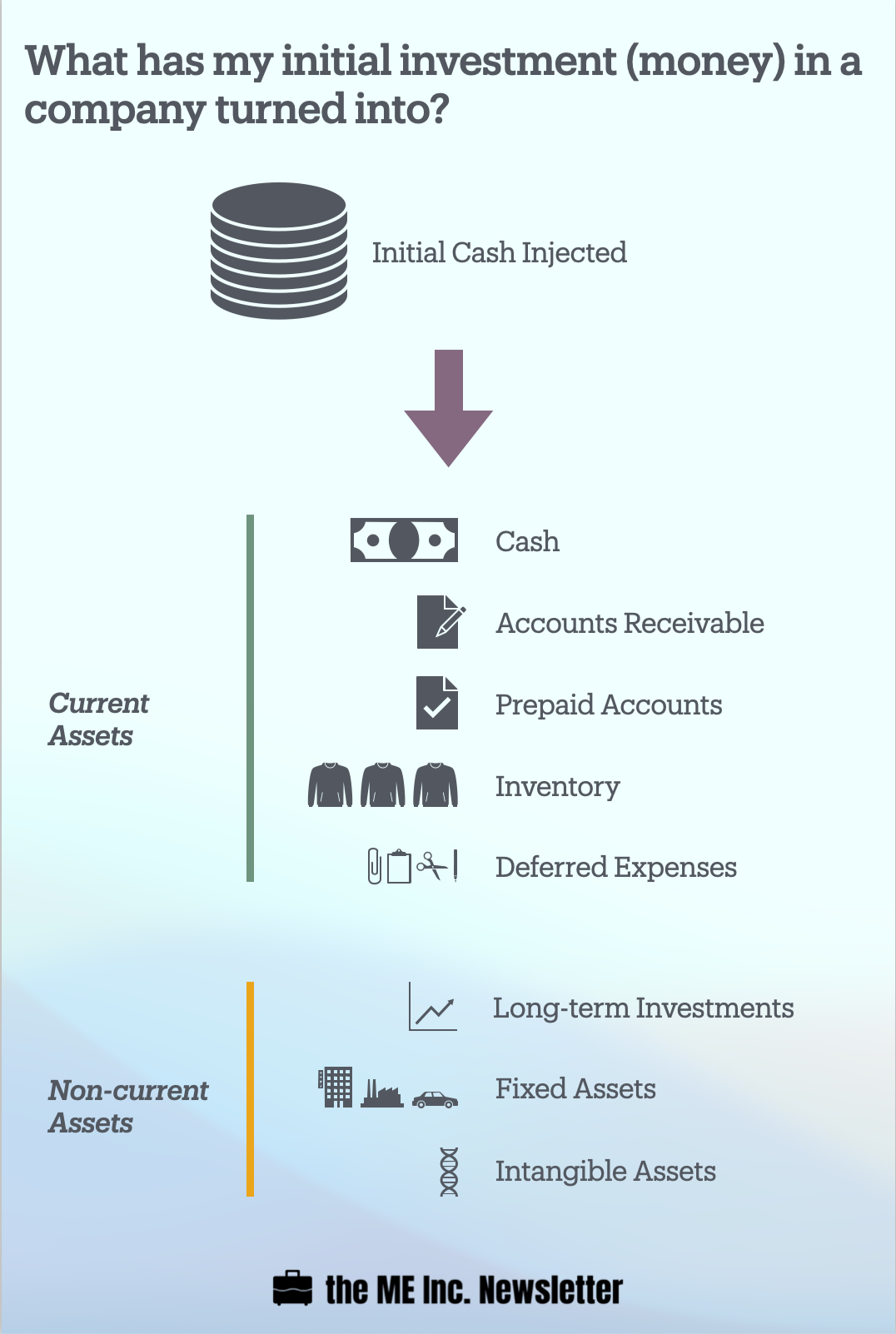
    What has my investment (money) in a company turned into?

    This is what the left side of the Balance Sheet – Assets – tells us. Instead of just a pile of cash lying in the bank, some has become accounts receivable, some raw materials, finished goods , or product in progress, some factory plants, cars, computers, and office buildings, some rights of the land, patents and proprietary technology. And some are still lying in the bank in the form of cash. Essentially the Assets on the Balance Sheet tells us what our originally invested money has been used for.

    Understanding Liabilities and Shareholders’ Equity

    What does the right side – Liabilities and Shareholder’s Equity – tells us?

    The right side tells us where your money comes from. While I might come up with a certain amount of money out of my personal pocket, I might also borrow money from the bank as loans. On top of that, I might also owe money to suppliers, customers, employees, or the Tax Bureau, etc.

    Assets = Liabilities + Shareholders’ Equity

    Obviously, the money raised (the right side of Balance Sheet) must be equal to the money spent (the left side of Balance Sheet). I cannot spend money I don’t have; or put it in another way, if I want to spend money I don’t have, I will have to borrow it from somebody else, thus owing them debts, and I cannot create assets out of thin air.
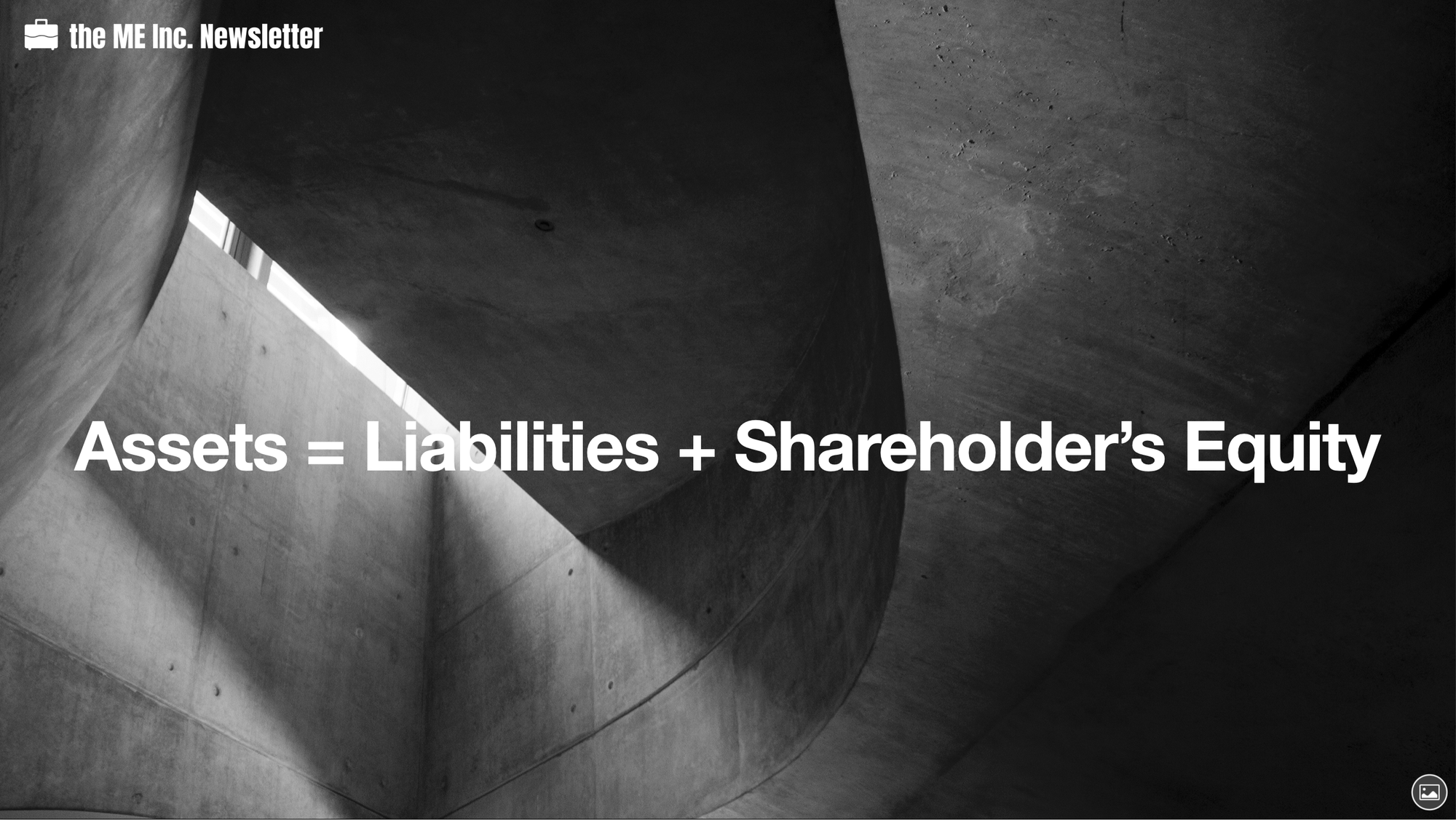
    Assets = Liabilities + Shareholders’ Equity

    Assets equal Liabilities plus Shareholders’ equity is the most basic logic on the Balance Sheet, and it is also the most basic in accounting.

    💡
    Assets = Liabilities + Shareholders’ Equity is considered an axiom. It is always correct, and must be obeyed in any financial statement.

    If you see a company’s statements do not conform to this relationship, the only possible explanation is that the statements are wrong. The equation must be obeyed at all times.

    The formula that assets equal liabilities plus equity can be easily restructured into two equations:

    1. By moving liabilities to the left, the equation becomes liability equal to the assets minus equity
    2. By moving equity to the left, the equation becomes equity equal to assets minus liabilities

    From a mathematical point, both restructured equations are correct. But from an economic aspect, only one is correct. Which one do you think it is?
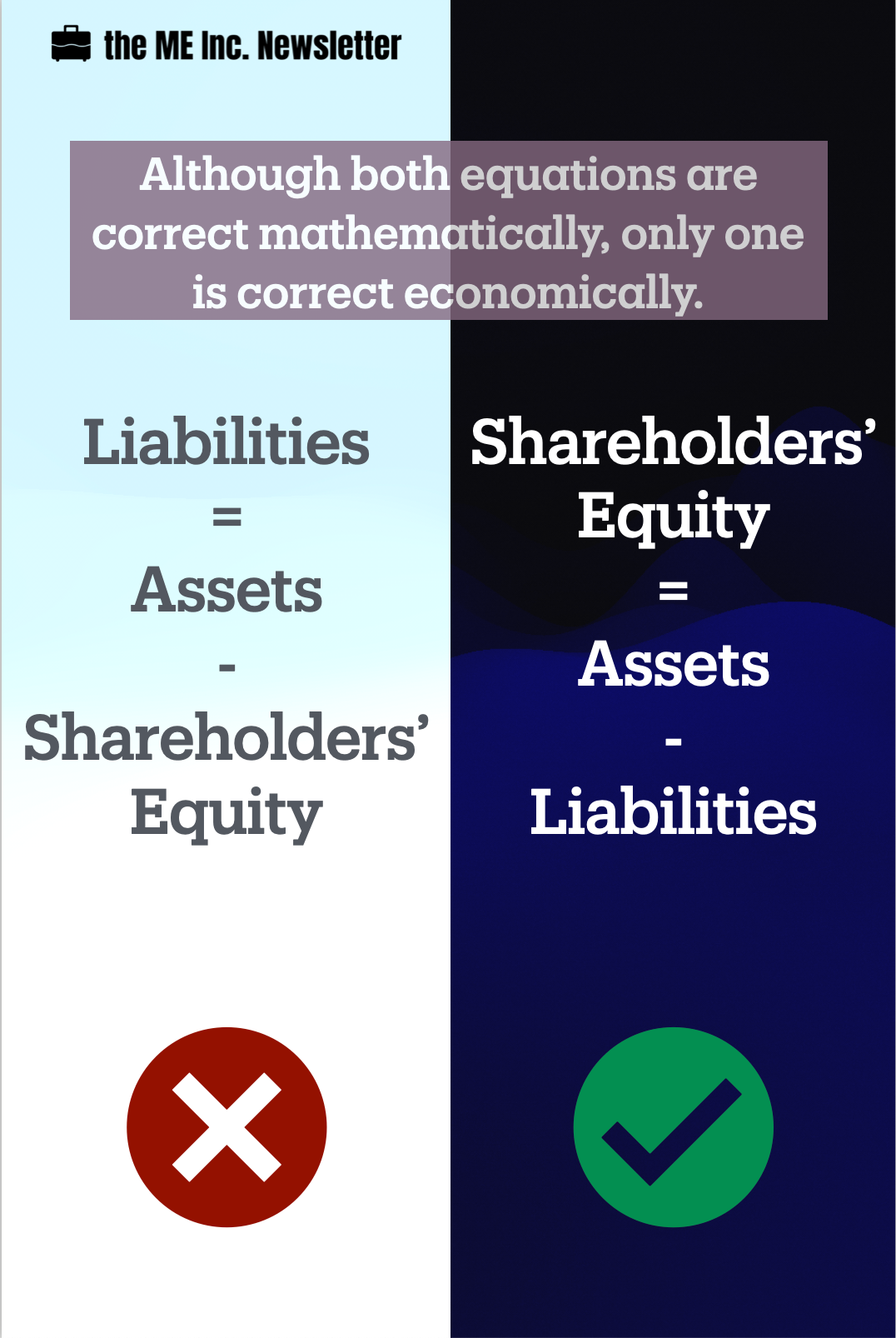
    Well only the second – shareholders’ equity = assets – liabilities – is correct. Why is that?

    Let’s look at the first. 

    The first equation means that after we allow shareholders to take back the money invested from assets, the remaining amount belongs to the bank. The owner of the company becomes the bank, which is not true.

    On the other hand, the second equation means that after the company pays all the debts we owe to the bank and the rest of creditors, the remaining assets belong to shareholders. The shareholders own the company.

    In other words, the shareholders own what’s left after the company repays all of the liabilities. This is called residual claims.

    What if the company runs well and its assets actually have appreciated over time (great news!)? 

    Well the bank will not ask you to repay more than your debt for your profitable business, since the debt to the bank is fixed. Therefore, the shareholders own the asset appreciation. 

    But if the company is running poorly, and its assets actually become devalued over time, the bank will not grant you to repay less debt. Then you might run into a financial crisis. My debt to the bank is always fixed, so the asset depreciation has to be borne by me – the shareholder.

    Then what is the ultimate goal for a company? A company should be making money for shareholders.

    Recall that at the beginning, I’ve established that before I ask if I’ve made any money from the company, I want to know if my investment, i.e. my principal, is still safe, or what it has become. The balance sheet helps me answer that question. It gives me a breakdown of all items that my money has become, and has put a dollar amount behind each item. The asset items are the resources I have in running the company. 

    If the balance sheet tells me that the total asset is worth 100 dollars, does it mean that the company has 100 dollars worth of assets now? In the past year, i.e. having this 100 dollars at all times over the past 12 months? 

    Of course, the first explanation is correct. That is, the company has 100 dollars worth of assets at this particular moment. It’s like I’m taking a photo of the resources of the company, documenting what it has right now, without bothering whether it will change into in the future. Neither do I care what it looks like before the picture is taken.
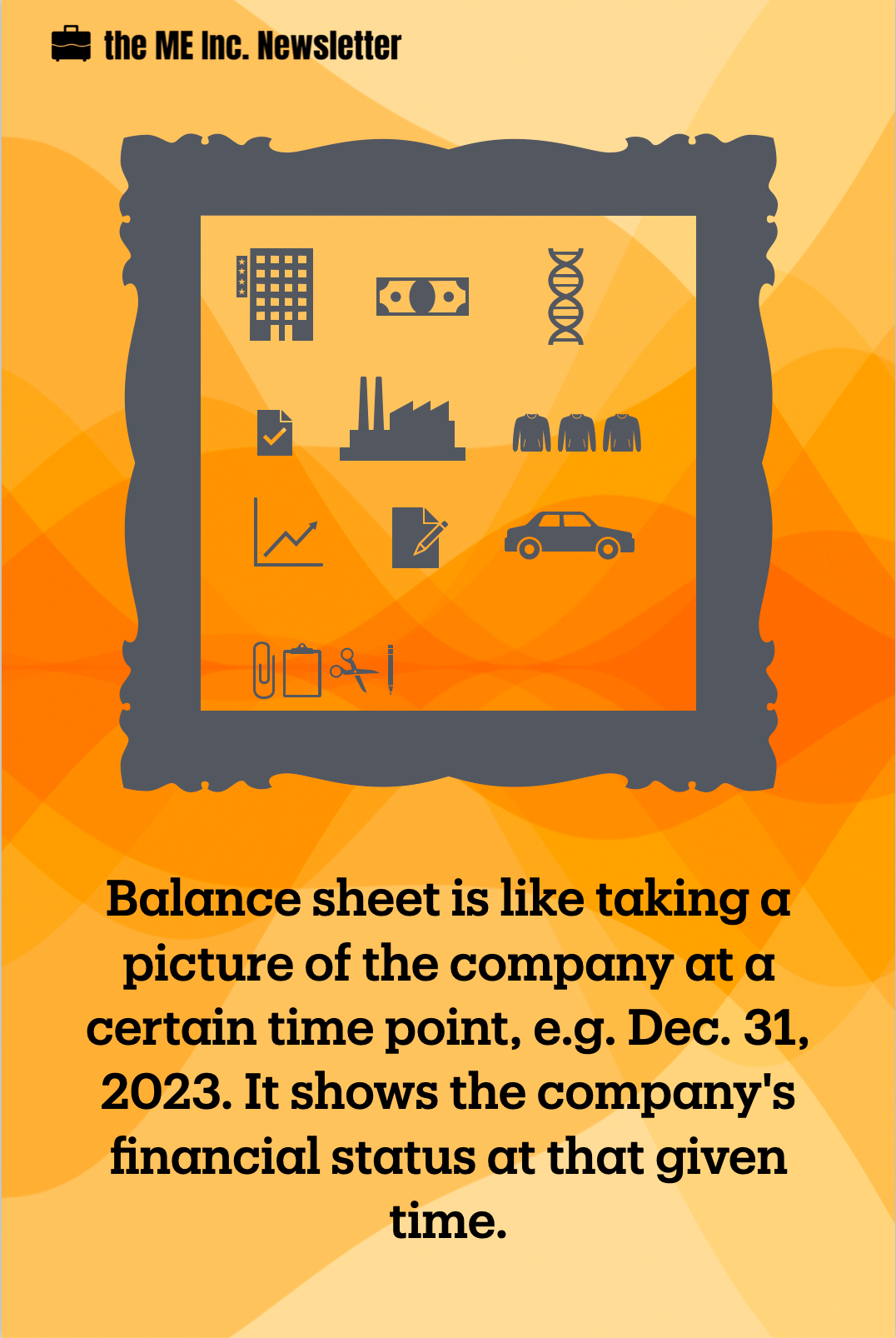
    Assets vs. Physical Properties

    Asset and physical property are two different concepts. 

    Here physical property means something tangible, i.e. physical things that I can touch. What could be an asset item that’s not a physical property? 

    Let’s look at the Assets on the balance sheet.
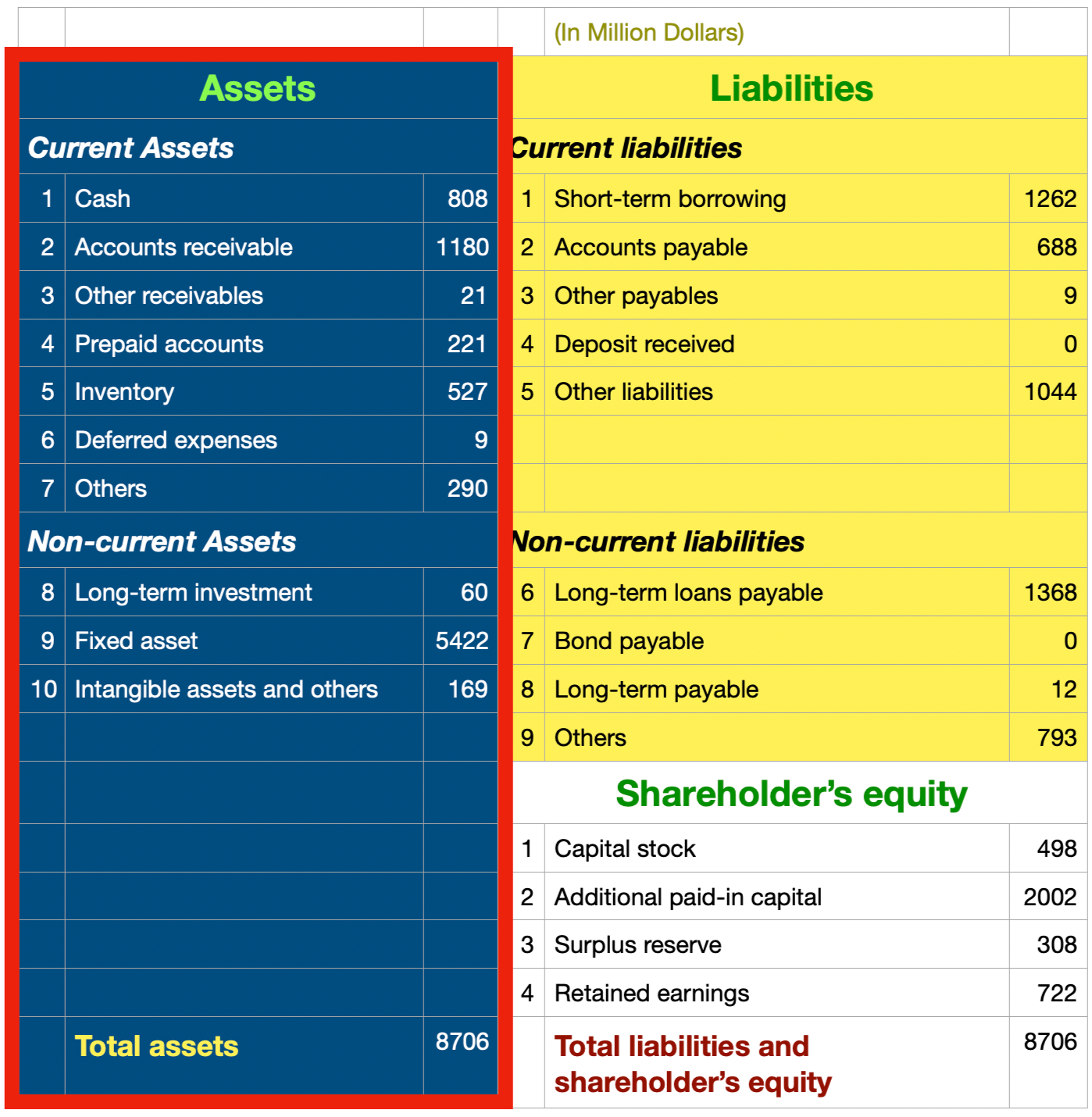
    Among all asset items, we see things such as accounts receivable, prepaid account, etc., that are just my rights. Even though I do own these rights to future claims, I cannot touch such a “right”, since it doesn’t have a physical form. Sometimes I don’t even have a certificate for them like a contract. However, we still say that this is an asset.

    On the contrary, sometimes we do have physical properties in presence, but they are NOT our assets.

    For example, I may rent someone else’s equipment. Even though I have the right to use it during that time, the equipment is not an asset item on my balance sheet. Another example would be the products I sell as a commissioned agent. Even though these products are stored in my company’s warehouse, they are not my assets.

    Relationship between Assets and Costs/ Expenses

    If you recall, there is an item called deferred expenses on the Balance Sheet that we discussed previously. Deferred expenses are really assets, but they will partially get expended as time goes by. Same thing happens for fixed assets and long-term deferred expenses. They gradually wear out, and the wear and tear become depreciation. 

    This depreciation is a kind of cost; put it in other words, assets today are costs tomorrow. They are the same thing in different times.


    Now we understand why we need a balance sheet; since our investment in the company has now become a variety of things, we want to know the value of my principal investment. And the Balance Sheet can help us do just that – it describes the financial position of our company at a particular point of time.
  • Shareholder’s Equity: the Last Piece on Balance Sheet

    In previous episodes of the Learning Finance series, I’ve learned Basics of Balance Sheet , different types of assets, how to use Balance Sheet to understand how companies work, and the basic rules of asset pricing system . I’ve also learned different types of liabilities. Now we will look at the last section on the Balance Sheet – Shareholder’s Equity.

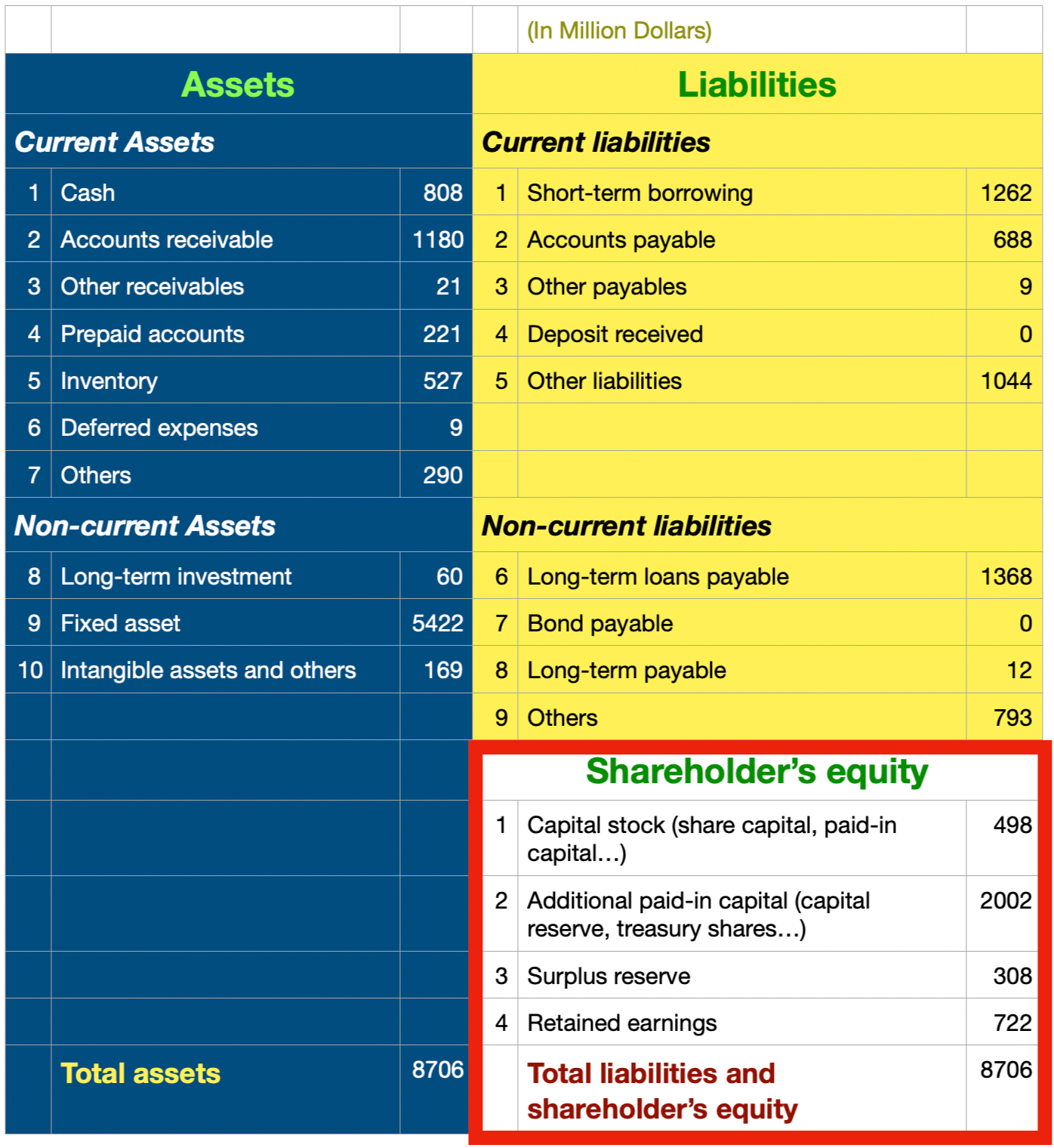
    There are four items in Shareholder’s Equity: 

    1. Capital Stock
    2. Additional paid-in capital 
    3. Surplus reserve
    4. Retained earnings

    Let’s go over these together.

    There are mainly two ways shareholders can invest in a company. 

    First, shareholders can inject money into the company as their investment. By doing so, the shareholder’s money will become the company’s money, and the shareholder will receive equity, i.e. proof of ownership in the company, in exchange. This is a form of external investment.

    Second, when the company makes a profit in its operations, the profit is originally owned by the shareholder. However, the shareholder may decide not to take the profit home but instead keep it in the company. This is also a form of investment, but internal.

    For the four items mentioned above, which ones are external, and which internal?

    It’s difficult to know the answer just by their names without fully understand what they are, but you can still guess that capital stock might be a form of external investment, and retainied earning is a form of internal investment. If those are your answers, then you guessed them right.

    But what about additional paid-in capital and surplus reserve?

    Right now, let’s just take note of the answer that additional paid-in capital is external, and surplus reserve is internal. By the end of this article, you will be able to understand what they are, and why.

    External Investments

    When capital comes in, it’s recorded on the Balance Sheet separately under two lines of items in the Shareholder’s Equity Section, Capital Stock and Additional Paid-in Capital.

    Why do we account them in two separate items?

    Capital Stock (Share Capital, Paid-in Capital, Equity…)

    This is arguably the most important item. At least I think that way. 

    However, this item can get a little bit confusing, since you may not always see the name Capital Stock on a balance sheet. Different types of companies may use different names for essentially the same thing. 

    For example, the concept of “stock” only exists in public companies, i.e. only when a company goes public will its stocks be created. So in public companies, you will see this item with the names like Capital Stock, Share Capital, etc. In private companies, or limited liability companies, the same item is called paid-in capital. However, no matter what names are used, the meaning is the same. 

    In certain countries such as China, every company needs a registered capital required by law. That is, when you form a company, you have to inject money into the new entity. The amount of money that you inject is called registered capital. In China, the value of capital stock (or share capital, paid-in capital) must be equal to the registered capital. In other countries, such registered capital requirements is not necessary, so this item won’t necessarily equal registered capital. All money invested is considered original fund of the company.

    However, you might be wondering this:

    If the actual money invested is more than the registered capital, where does the extra money go on our Balance Sheet?

    The answer is Additional paid-in capital.

    Additional Paid-in Capital (Capital Reserve, Treasure Shares…)

    There is one type of company that will always have additional paid-in capital on its balance sheet. That type of company is publicly traded company. Why?

    We know that publicly listed companies issues shares to the public. For example, when it issues 100 million shares of stock at 20 dollars per share, how should we record this transaction?

    By doing some simple math, we know that the company raised 2 billion dollars. Since the nominal value per share is one dollar, we will record 100 million dollars as Capital Stock. The rest 1.9 billion dollars will be kept in Additional Paid-in Capital, as known as Capital Reserve or Treasure Shares.

    The above example described how a publicly traded company accumulates capital reserve. But how can private companies generate additional paid-in capital? Let’s look at this example.

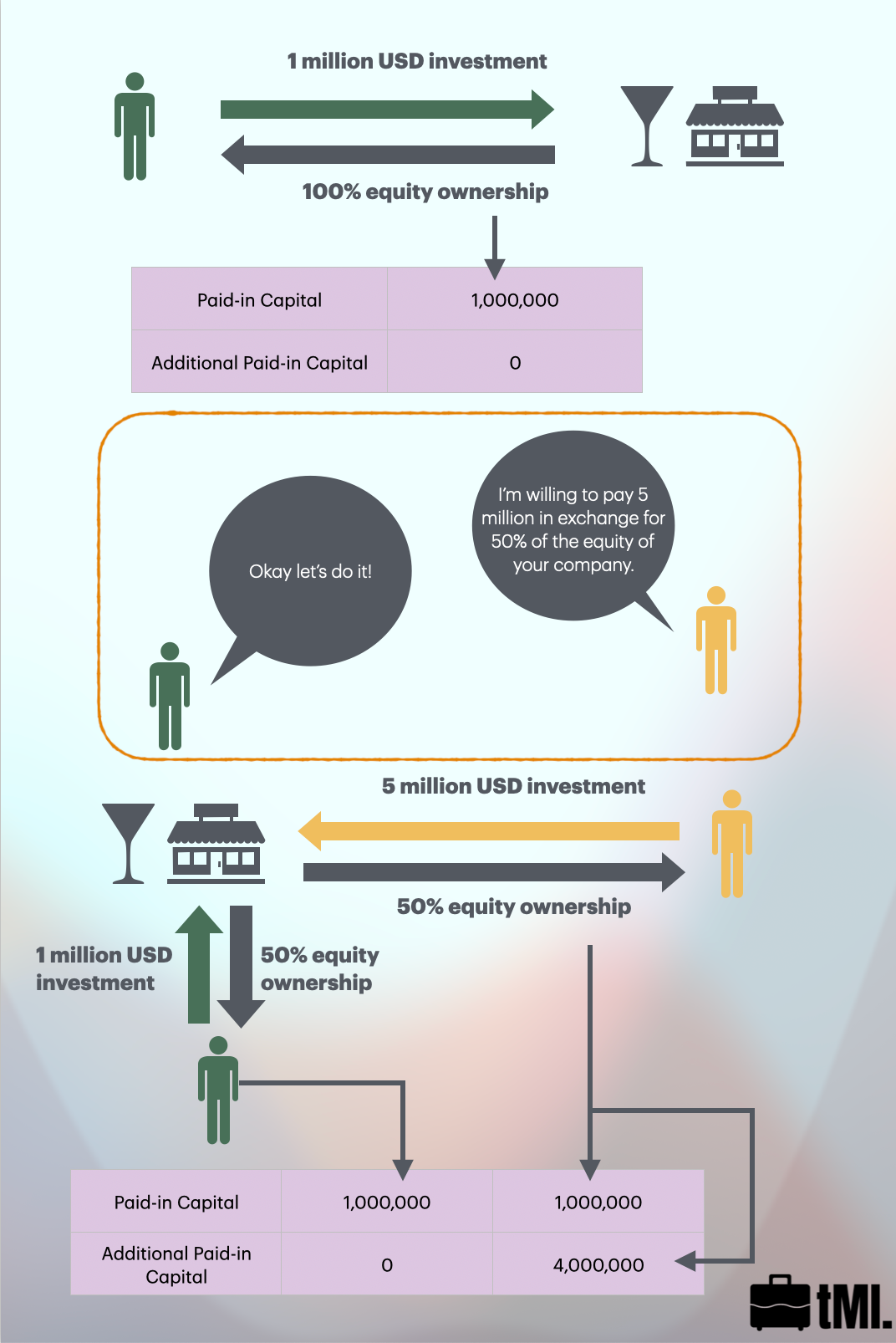
    Say I invested one million dollars to start a small company. After a few years, the business runs well, and someone is interested in investing in my company. After some due dilligence and negotiations, we finally reached a deal: I agreed to sell 50% of the company for five million dollars. In other words, we both agreed that the company is worth 10 million dollars now.

    But the thing is that I invested one million dollars and my new partner will invest five million dollars. How can I document this investment on the Balance Sheet so the shares are split 50/50, not 5/6 for him and 1/6 for me?

    The answer lies in additional paid-in capital.

    Out of the five million dollars, one million will go in paid-in capital, matching my initial one million-dollar investment and boosting the total equity to two million. The other four million dollars will go into additional paid-in capital. Since ownership percentage is only calculated by paid-in capital, the company’s ownership is now split equally between the two of us. The other four million dollars in the additional paid-in capital are now owned by all shareholders of the company.

    That means I now own two million dollars out of the four. The second this investor invested five million dollars in my company, two million dollars will evaporate instantaneously out of his pocket. Why did he do that?

    When I started the company from my own one million dollars, the company was worth just that. But after so many years, I’ve built up the company to a higher level, far more valuable than what it was. From this perspective, the investor exchanged his two million for the 50% of the company income in the future.

    💡
    Paid-in Capital (or Equity) is a very important item, a concept of great legal significance. 
    First, at least in China, the total amount of Paid-in Capital is equal to the company’s registered capital, which is the company’s maximum external legal liability should it be subject to bankruptcy
    Second, the capital structure reflects the division of interest among the company’s shareholders. That is, when the company has more than one shareholder, the division of shares is NOT in accordance with each shareholder’s total capital contributions, but with the proportion of Paid-in Capital. 

    Internal Investments

    When a company makes a profit, the shareholders can choose to either distribute those profits to themselves or keep them in the company. If they choose to keep the profits in the company, those profits essentially become internal investments.

    Surplus Reserve (only in certain countries)

    Surplus reserve is profit that cannot be distributed by the law. In some countries such as China, the law stipulates that a company must retain some profit as surplus reserve in the company. In other words, if the company earns 10 million dollars this year, I must leave at least one million in the company as surplus reserve. 

    Shareholders are free to distribute the remaining nine million dollars; for example, they may decide to distribute three million dollars to all shareholders, and leave six million dollars in the company.

    Retained Earnings

    Where should we put the remaining six million dollars? In the retained earnings.


    By far we have gained a more complete understanding about the balance sheet. We’ve already known the meaning and composition of assets, liabilities and shareholders’ equity respectively. Later we will look at how the balance sheet presents a complete picture of a company’s finance.

  • Liabilities: Current and Noncurrent

    In previous episodes of the Learning Finance series, I’ve learned Basics of Balance Sheetdifferent types of assets, how to use Balance Sheet to understand how companies work, and the basic rules of asset pricing system. Now we are moving on to the right side of the Balance Sheet.

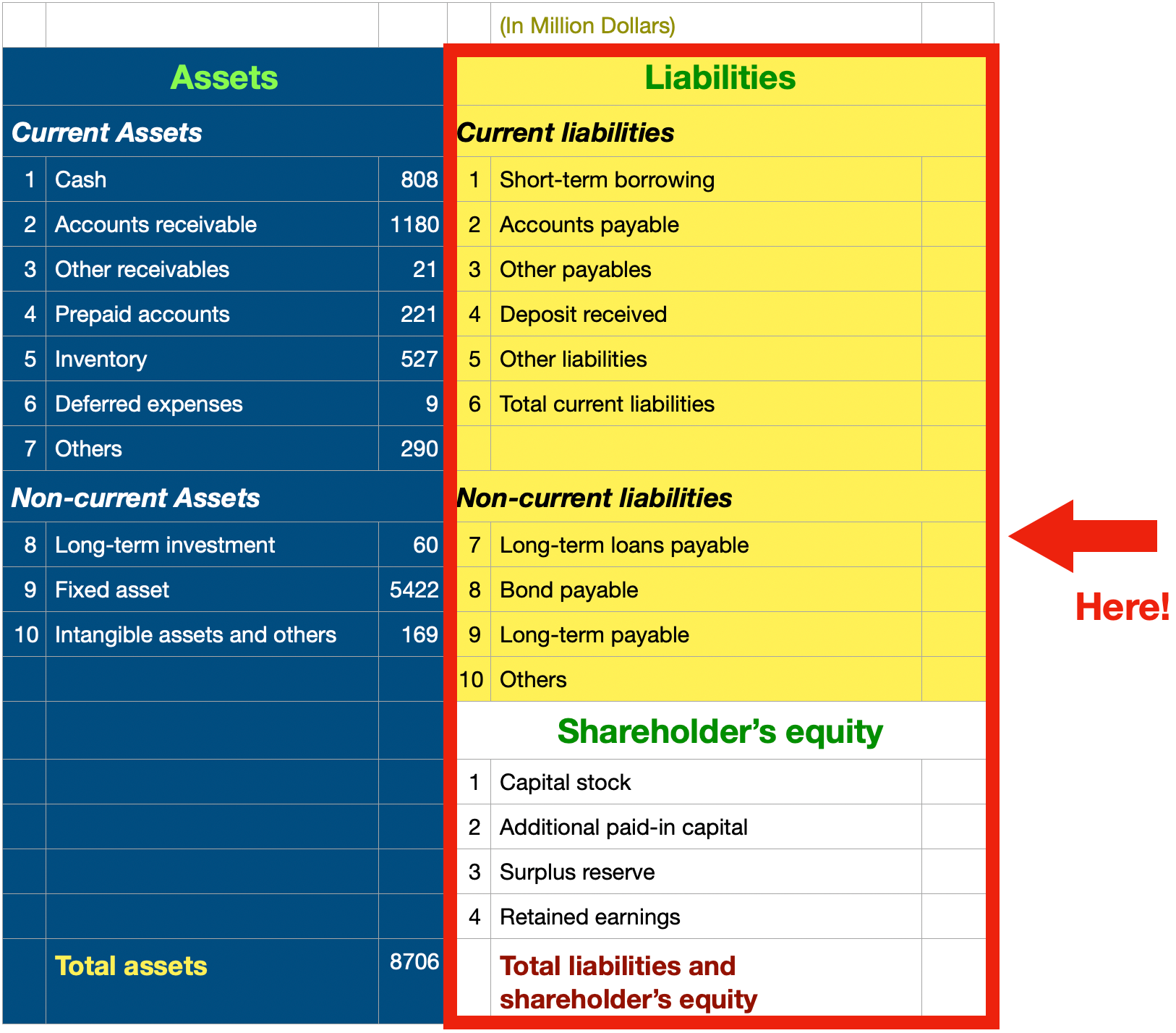
    On the right side of the balance sheet there are two sections – liabilities and shareholder’s equity. Let’s get into liability first. 

    Current vs. Non-current Liabilities

    Similar to how assets are structured into current and non-current ones, liabilities are also structured the same way. Current liabilities are to be repaid within the next 12 months, and non-current liabilities beyond 12 months. Pretty easy to remember. 

    Current Liabilities

    Short-term Borrowing

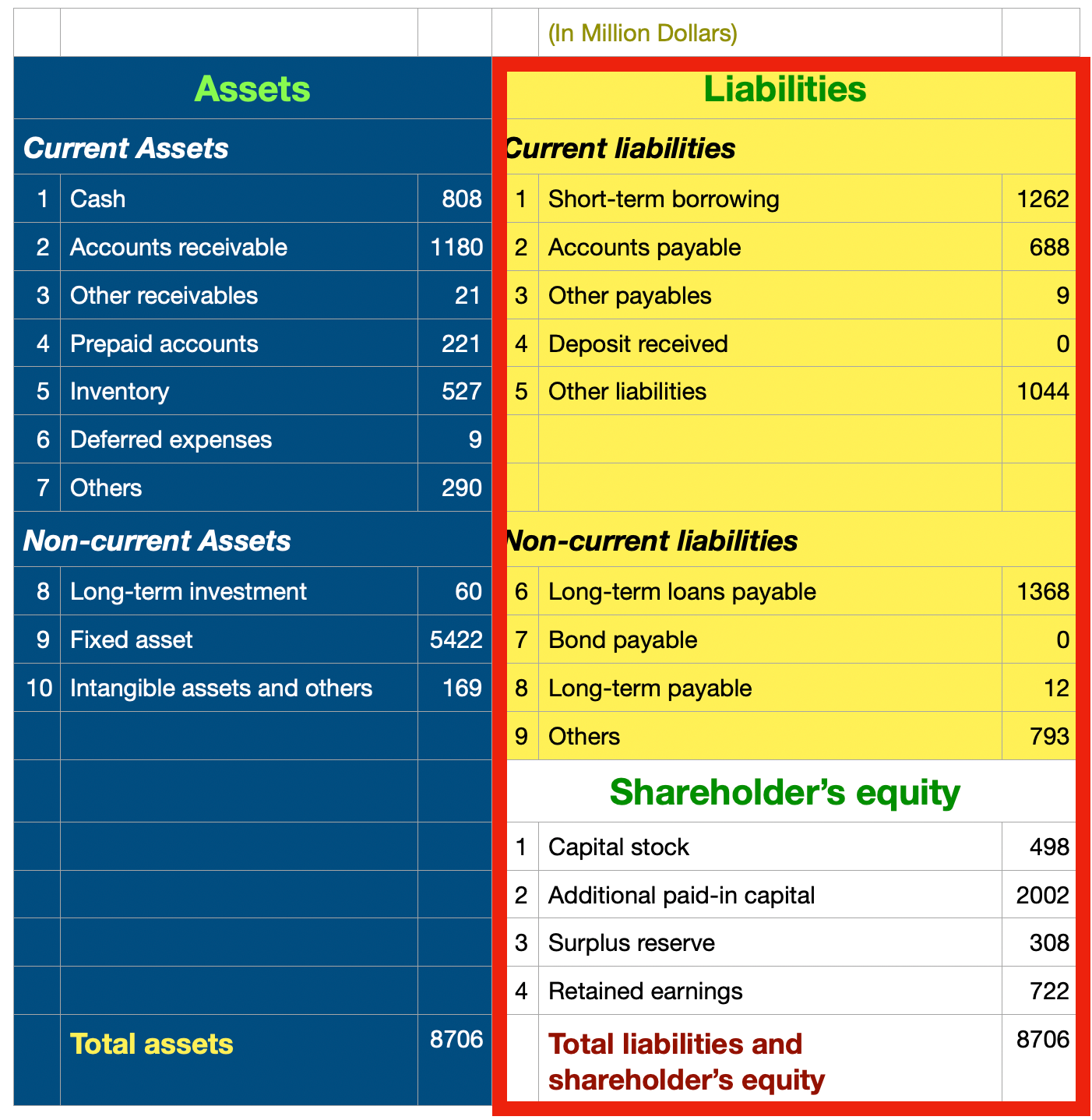
    Short-term borrowings are bank loans with a 12-month or less maturity. Bank loans beyond that will be considered as long-term debt or long-term loans payable. For our company in the Balance Sheet, it has over 1.2 billion dollars of short-term borrowings.

    Accounts Payables

    Whom will a business owe money to besides banks? 

    Well when a business sells goods to a customer, the customer may not pay the business right away, i.e. owing money to the business. Thus, the business has accrued accounts receivable, i.e. the right to collect the agreed-upon amount of money at a later time, and meantime, the customer has accounts payable with the same amount, i.e. the obligation to pay the business the agreed-upon amount of money at a later time. For our company, it has 688 millions of accounts payables.

    Other Payables

    One example would be one of my friends has a temporary cash flow issue, so he borrowed a million dollars from me. What do we call this? To me the lender, it is other receivable; to him, it is other payable. For our company, it has 9 million dollars of other payables.

    Deposits Received

    Now let’s go back to the situation when we purchase raw materials from the supplier. The supplier may ask for an upfront deposit, or prepaid accounts. This advance to supplier grants me the right to receive delivery of goods, and all goods are rightfully my assets. This prepayment will also become the supplier’s obligation, or a liability. This particular liability item is called deposits received, or advances from customers. Our company doesn’t have any deposits received from its customers.

    Other Liabilities

    There are many other items in the liability category, which are put into one line of item called other liabilities. This item is actually a combination of a number of items, so we need to break it down. 

    If you look at it carefully, you will find this item is not a small amount; it is over a billion dollars. What do you think might be included in there?

    In other words, whom will the business owe money to besides the bank, the suppliers and the customers?

    Well first, almost all businesses owe money to their employees, since most businesses pay wages in the next month after their employees have provided their services. Of course this liability will be paid off very soon, or else employees will soon become ex-employees. This salary owed to the employees is called accrued payroll.

    All businesses also owe money to the tax bureau on a regular basis, for the reason that most businesses don’t prepay taxes. What they do instead is paying taxes in the next month. So when the accountants prepare financial statements at the end of each month, there are taxes owed to the tax bureau. This liability is called taxes payable.

    As a matter of fact, almost every business has accrued payroll and taxes payable.

    Non-current Liabilities

    Long-term Loans Payable

    We went through this item briefly when we were talking about short-term borrowing. Long-term loans payable are essentially bank loans beyond 12 months. Our company has over 1.3 billion dollars of long-term loans, more than its short-term borrowings.

    Bond Payable

    Bonds are debt products issued by the company, and not all companies can issue bonds. As you can see, our company has no bond payable.

    Long-term Payable

    Long-term payables are related to certain specific kind of transactions such as leases. 

    Normally when we rent something, the ownership of the product is not transferred. But in accounting, there might be instances where we need to document leases in the Balance Sheet. 

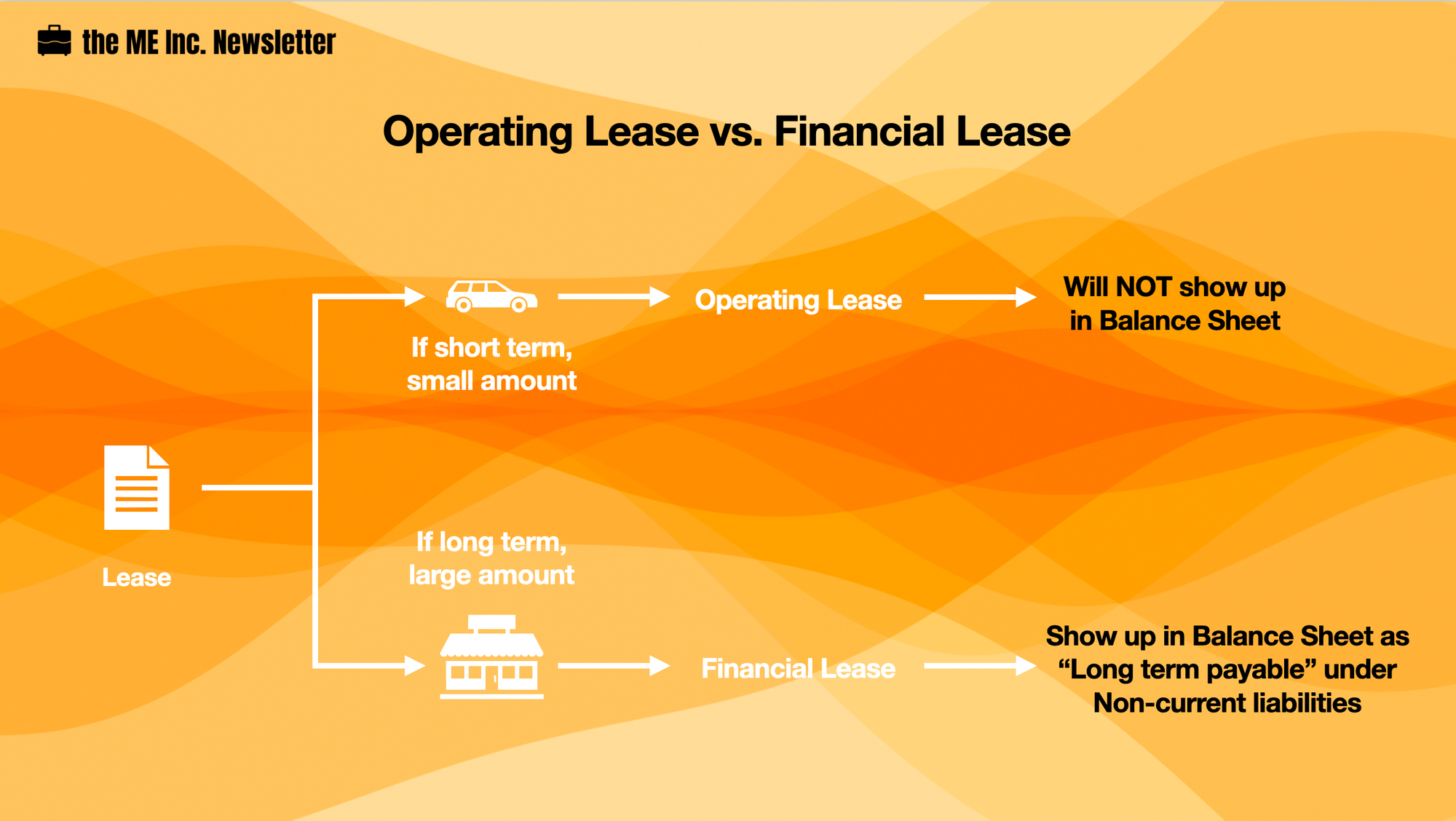
    Leases are divided into two categories – operating leases and financial leasesOnly financial leases are long-term payables.

    When a lease is relatively long, and involves a large amount of money, it is often treated as a financial lease. Otherwise it is an operating lease. If a lease is considered an operating lease, then we are renting something we don’t own, i.e. the ownership is NOT transferred. Operating leases are expenses paid out by the company, therefore they don’t show up on the balance sheet. 

    Financial leases, on the other hand, are treated as if we are paying a loan for an asset. Therefore, it means that the ownership of the asset is transferred, and the rentals are portions of the loan. In fact, from the moment we sign the lease contract of that asset, all the future rental expenses will turn into liability, also known as long-term payable.

    Operating lease vs. Financial Lease
  • Fair Value vs. Historical Cost: Rules, Applications, and Exceptions

    In the previous episodes of the Learning Finance series, I’ve learned the Basics of Balance Sheet, have learned the different types of assets, and how to use Balance Sheet to understand how companies work.

    Every asset item is followed by a number, and that number is the value of that asset. How can I determine the value of an asset?

    Historical Cost vs. Fair Value

    I’m facing two choices:

    1. I can use the sum of money that I spent when I bought the asset at the time, i.e. the purchasing cost of the asset.
    2. I can use the current fair value, i.e. market price of the asset.

    At first, I’m tempted to use the fair value of the asset because it reflects the real value of the asset. This may work for me personally, but if I want to one day sell the company, this method could potentially be challenged. After all, it is impossible for me to find a selling price for every single asset in the market. For example, if I have a set of equipment in the past five years, I won’t be able to find a fair value for the equipment right away. 

    I thought about using the price of a new set of equipment with the same model, and I could then apply a discount to the price. However, even this seemingly feasible method contains flaws.

    What discount percentage should I use?

    10% of the original price?

    Or 90% of the original price?

    Both are “discounts” applied against the fair value of the equipment, but the gap between them is simply too large, thus rendering the method NOT objective.

    Accountant is a profession of prudent and conservative nature. Accountants dislike uncertainty, and when they face them, unwillingly, they’d rather err on the side of conservativeness, i.e. they would rather underestimate revenues and overestimate costs than vice versa.

    After eleminating the second option of determination of an asset’s price, I’m left with the first and only option, which is to use the original purchasing price as value of an asset. Because this transaction happened in the past, there is less room for dispute. 

    However, even though doing so offers me peace of mind, it also creates a new set of challenges. Because the value of many assets have fluctuated over the years, the original price doesn’t reflect the current reality. For instance, if I bought a piece of land 10 years ago for 500,000 USD, the current value of the land can easily go above 50 million USD in certain countries. Yet on the balance sheet, the land is still recorded as 500,000 USD – its original purchase price.

    Even though this imperfect dilemma exists, using the original purchasing price to document the value of an asset is still my best option. Most countries on this planet have adopted this method, and in accounting terms, it is called historical cost of an asset. In fact, accountants, with their conservative and prudent nature, will even go further than using historical costs of assets; that is, if there was a value increase of the asset, they would “pretend” the increase never happens, but if there was a value decrease of the asset, they would document this decrease with a deduction (what an a**hole!). So if I want to be specific, the asset pricing system is a historical cost system with deduction on devalued assets.

    The goal of a Balance Sheet is to reflect the real value of assets. Because often there lacks a common, objective standard in valuing the market value of an asset, we have to use the historical cost in the asset pricing mechanism as our second-best choice.

    Now we have established that in pricing assets, the historical cost system is the way to go. Is there a type of asset with a relatively objective fair value, a price that everyone is likely to agree on at any given time? 

    There actually is.

    Financial Asset – An Exception to Historical Cost

    If you think about it, one such type of asset will be public stocks. On any given day, the stock price of any public company is set by the stock market. People all over the world can see and trade on stocks, and there is little argument in the objectiveness of public stocks. 

    This asset category is called financial asset, among which stocks are part of. Because there exist an active market for most financial assets, people can reach consensus on their fair values. Therefore, there is no need for us (and the accountants!) to use historical costs for financial assets, since we have a better option to value them. We can simply use fair value for financial assets on our balance sheet.

    Real Estate – Another Exception (with Caveat)

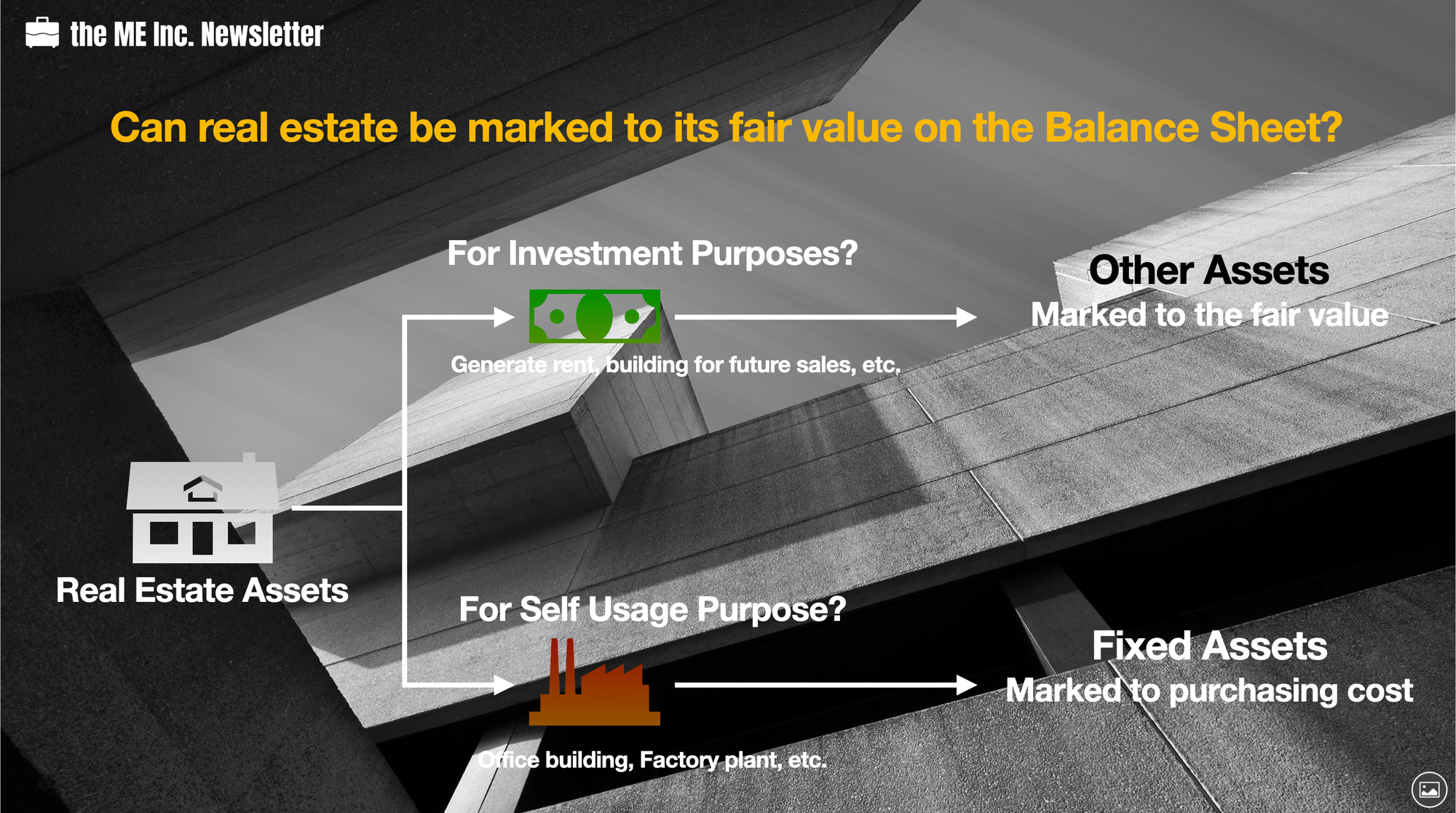
    Other than financial assets, is there any other asset with this character? Well, you guessed it – real estate, but not any type of real estate, only real estate intended for investments. 

    Next to financial assets, the real estate market is also active, thus its price objective and transparent. However, our intended usage does make a difference here; ONLY if our goal is to lease the property to tenants, or hold and sell at a later stage, etc., i.e. treating the real estate as investment, then we can use the fair value in documenting the value for the real estate. If we intend to use the property as office building or manufacturing plant, we will have to resort to using the purchasing price as its value on the balance sheet. 

    Understanding Economic Activities

    In a nutshell, financial assets and real estate intended for investments are recorded with their fair values on the balance sheet. Other than those, most asset items are measured at historical costs with deduction when they devalue. 

    Understanding how asset values are measured can help explain why companies conduct transactions that may appear difficult to understand. For example, a company sells out one of its assets, but buys it back a week later. The asset changes very little during this week; so why does the company even bother to do all of these? 

    The reason that this company risks all the trouble is related to the concept of historical cost. Because of this rule, the value of this asset on the balance sheet is always equal to the purchasing price, as long as it’s not sold. To increase the value of this asset, the only way is to make a new deal, i.e. selling and buying it back. 


    By now, we’ve learned the meaning of each asset items, the structure of assets, and how assets are valued. We have already gained a comprehensive understanding to assets – the left side of Balance Sheet. All definition of terminologies such as cash, fair value, etc. can be found from here. Next we will liabilities and shareholder’s equity – the right side of Balance Sheet.

  • Analyze Balance Sheet to Understand How Companies Work

    Why do we need to read a Balance Sheet? It’s not fun.

    The goal is to understand how a company actually works. 

    Although we understand the asset items now, they are isolated from one another. How can I “see” a real company when all the pieces of asset items are put together?

    This is truly about how to “read between the lines”. Let’s look at the same Balance Sheet again.

    Manufacturing Companies

    Can you identify the biggest asset of this company? 

    If you check carefully, you may discover that fixed asset is the largest item of asset. For this company, the total asset is around 5.4 billion USD.

    What about the second largest asset item?

    Accounts Receivable – it’s worth about 1.2 billion USD.

    If a company’s largest asset is fixed asset, and the second largest one is accounts receivable, what business do you think the company is in?

    This is pretty easy to guess. And yes, you might have guessed it – it is a manufacturing company. What’s more, it is a capital-intensive manufacturer requiring upfront asset investment. 

    What about competition? 

    Considering that its second largest asset is accounts receivable, and accounts receivables allow our customers to pay later, making our goods more competitive in the market, it’s safe to say that this company is facing serious competitions in the market.

    As a matter of fact, high fixed assets, high accounts receivables are two traits commonly found in most competitive manufacturing companies.

    Service Companies

    In our daily lives, we might face more companies in the service industry, and for most of us interested in entrepreneurship, manufacturing is not something we look forward to starting a company in. So what does the balance sheet of a service company look at?

    Let’s use a design company as an example.

    A design company is essentially just a bunch of people working on their computers in an office. You may guess intangible assets are what the design company has, such as brands, technology or even goodwill. But what if this is a newly formed company, with neither brand power nor goodwill, and it solely relies on brains and has no patent?

    For this infant company, the most valuable asset of is people – the employees. This is easy to understand. But how can “people” be reflected on the balance sheet?

    Maybe under intangible asset?

    Or fixed asset?

    The answer is actually neither. Even for companies whose most valuable resources are people, such as a design company, they won’t put people under the asset.

    Employees are hired, not owned by the company. They are not assets that can be sold or disposed.

    Pro Sports Clubs and Pro Athletes

    But is there any scenario where people actually become assets?

    Well, there actually is. 

    Professional athletes in Europe or North America get paid huge salaries for performing at the highest level on earth. We often hear that pro players get multi-million contract extensions. Within the contract period, the athletes play for their own franchises, but the franchises can also trade players with other counterparts. In this case, professional athletes are more like assets, which can be bought or traded among multiple parties (clubs). For example, if a club signs a $150 million, 5-year contract with a star player, that money should be put in the deferred expense item, since the player contract is creating some future benefit to the club. 

    Agricultural Companies

    Now we have looked at people, what about animals? There are many companies in the agriculture industry.

    For these companies, animals such as chicken or pigs are referred to as biological assets. Animals and plants all belong to this category.

    Let’s say I have a farm cultivating chicken. Where should I put my chicken on my balance sheet? Well one thing for sure is that there won’t be an item called chicken.

    I’m tempted to treat my chicken as goods; so I should treat them as inventory. However, that might only work in half the situation. 

    Since my farm cultivates both roosters and hens, I will need to treat them differently. Well roosters are cultivated mainly for the meat, hens are actually for the eggs. From this perspective, roosters should be treated as inventory, because they can turn into cash in a single cycle, while hens should be treated as fixed asset since they last longer than a single cycle and can generate future value.


    As we learn deeper and deeper in this topic, you may find out that except for financial sector, almost all industries use the same format of financial statements. However, behind the same format are vastly different companies operating in different industries with different business structures. The same asset item may have completely different meaning in different industries too. When all these assets are organized, they paint a picture of a real, lively company.